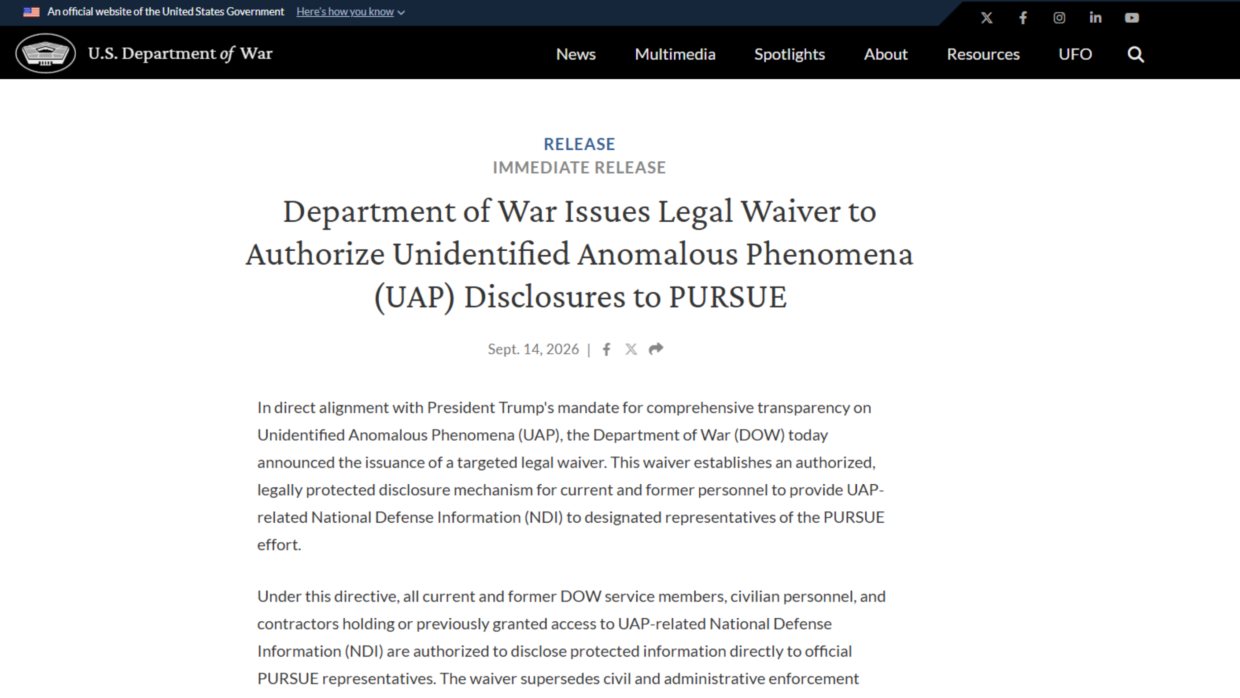
he September 14 waiver allows current and former defense personnel and contractors to share protected UAP-related national defense information with designated PURSUE representatives. It does not authorize public disclosure or automatically declassify classified information.
The U.S. Department of War has issued a targeted legal waiver intended to remove nondisclosure restrictions for current and former personnel who possess protected information related to unidentified anomalous phenomena, or UAP.
In a September 14 announcement, the department said current and former service members, civilian employees and contractors who hold — or previously held — access to UAP-related National Defense Information may disclose that information directly to designated representatives of the Presidential Unsealing and Reporting System for UAP Encounters, known as PURSUE. Department of War announcement, September 14, 2026
The department says the waiver overrides civil and administrative enforcement provisions contained in relevant nondisclosure agreements and Special Access Program Indoctrination Agreements, or SAPIAs, specifically when information is provided through the authorized PURSUE channel.
That is a significant procedural change. But its scope is narrower than a general release from secrecy obligations.
The waiver creates a protected route — not permission to go public
The most important limitation is explicit in the department’s own announcement: the relief applies to disclosures made directly to official PURSUE representatives.
It is therefore not a blanket cancellation of UAP-related nondisclosure agreements, nor does it authorize current or former personnel to provide classified information to journalists, researchers or the general public.
According to the department, material submitted through the process will be subject to review, security evaluation and possible declassification. That sequence matters. Information can be disclosed to authorized officials without automatically becoming public information.
The announcement also specifically names Special Access Program Indoctrination Agreements. SAPs are among the most tightly controlled categories of classified government activity, with access restrictions beyond ordinary classified programs.
That reference is likely to attract attention because some of the most consequential UAP allegations made in recent years have involved claims about hidden special-access activities.
But the waiver should not be treated as confirmation that any particular alleged UAP retrieval, reverse-engineering or technology program exists. It establishes a mechanism for people with relevant information to report what they know. Whether the resulting claims are supported by documents, physical evidence or independent corroboration is a separate question.
UAP whistleblowers already had a legal channel through AARO
The September 14 action also needs to be distinguished from protections that already exist under federal law.
Congress created an authorized UAP reporting mechanism in the Fiscal Year 2023 National Defense Authorization Act. That framework, now codified at 50 U.S.C. § 3373b, allows qualifying information to be reported through the All-domain Anomaly Resolution Office, or AARO, even when the individual is bound by a nondisclosure agreement.
The statute states that an authorized disclosure through the established mechanism is not subject to the individual’s NDA and includes statutory protections against reprisals such as adverse personnel actions or security-clearance retaliation. 50 U.S.C. § 3373b — UAP reporting procedures
AARO itself continues to tell current and former government personnel and contractors that classified UAP-related information can be provided through secure authorized channels, while warning that such information must not be submitted through its ordinary web form. AARO’s official reporting guidance
The new PURSUE waiver therefore does not create the first lawful way for people bound by secrecy agreements to report UAP information.
What it appears to do is expand and operationalize another channel specifically connected to the administration’s disclosure and declassification program.
The September announcement follows an earlier intelligence-community memo
The waiver has also been developing for several weeks rather than appearing without warning.
On July 31, Principal Deputy Director of National Intelligence Aaron Lukas signed preliminary guidance instructing the Department of War and Intelligence Community to establish a process allowing current and former personnel to provide UAP information to authorized AARO or PURSUE representatives despite previous NDAs, agreements, oaths or commitments.
Representative Eric Burlison publicly released that memorandum on August 1 after saying the administration had authorized its distribution. Burlison’s release of the July 31 implementation memorandum
The new September 14 announcement is important because the Department of War is now stating that the targeted legal waiver itself has been issued and describing the specific categories of agreements it overrides for disclosures to PURSUE.
PURSUE was launched publicly earlier this year following President Donald Trump’s February 19 direction to identify and release government material concerning UAP, UFOs and alleged extraterrestrial life.
The Department of War began publishing PURSUE records on May 8 and has subsequently released additional tranches of documents, imagery and video. Its official portal currently lists five releases, the latest dated August 7. Official PURSUE records portal
Important legal questions remain unanswered
The September 14 release is only a short announcement. It does not publish a detailed legal analysis explaining every boundary of the waiver.
In particular, the department says the waiver supersedes civil and administrative enforcement provisions in NDAs and SAPIAs, but the announcement does not describe blanket immunity from every criminal law governing classified information.
Nor does the release separately spell out whether someone using the PURSUE channel receives precisely the same statutory anti-reprisal protections that Congress established for authorized disclosures through AARO.
Another unresolved issue concerns Congress.
Before the implementation guidance was released, Burlison said his office was uncertain whether the NDA waiver would also apply when a witness provided information directly to Congress before referral to the executive branch. The September announcement specifies communications to official PURSUE representatives and does not expressly answer that question.
Those distinctions could matter greatly to potential witnesses deciding whether and how to come forward.
The real test is what enters the record
From a disclosure perspective, the significance of the waiver will ultimately depend less on its announcement than on what happens next.
For years, one recurring explanation for the lack of first-hand testimony and documentation concerning alleged deeply classified UAP programs has been that witnesses feared prosecution, loss of clearances, financial penalties or career consequences if they violated secrecy agreements.
The Department of War is now explicitly saying that those agreements should not prevent covered individuals from speaking to PURSUE through the authorized process.
That removes one claimed barrier.
It does not establish that extraordinary programs or technologies exist, and it does not validate allegations simply because someone is now permitted to make them.
The next meaningful evidence will be whether witnesses actually use the mechanism, whether their claims can be corroborated, whether relevant records are identified, and — crucially for public disclosure — whether any resulting material survives security review and is eventually released.
That is where the evidentiary value of this new policy will be determined.
Sources
- Department of War — Legal Waiver for UAP Disclosures to PURSUE, September 14, 2026
- Department of War — PURSUE official portal and records collection
- AARO — Official UAP reporting guidance
- U.S. Code — 50 U.S.C. § 3373b, Unidentified Anomalous Phenomena Reporting Procedures
- Rep. Eric Burlison — July 31 NDA waiver implementation memorandum release