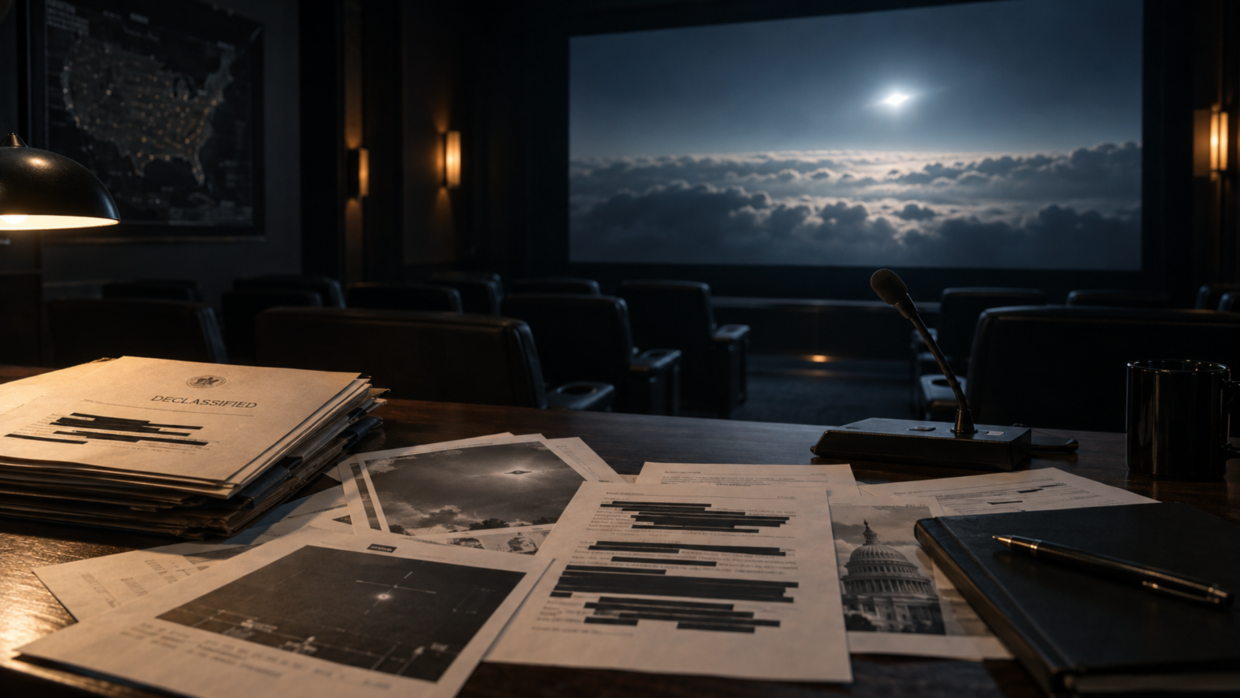
Steven Spielberg’s latest extraterrestrial film is fiction, but its starting point is unusually contemporary: Pentagon UAP videos, congressional testimony, whistleblowers and the belief that information about non-human intelligence could be hidden outside normal government oversight.
When Steven Spielberg made Close Encounters of the Third Kind in 1977, he was imagining what contact with an extraterrestrial intelligence might look like.
Nearly five decades later, Disclosure Day begins from a different premise.
The question is no longer simply whether something unknown might be visiting Earth. It is what would happen if convincing evidence already existed — and someone was deliberately preventing the public from seeing it.
Released theatrically on June 12, 2026, Disclosure Day stars Emily Blunt, Josh O’Connor, Colin Firth, Eve Hewson and Colman Domingo. Spielberg created and directed the film from his own story, with a screenplay by longtime collaborator David Koepp. Universal describes it around a simple question: what happens when proof that humanity is not alone belongs to everyone rather than those keeping it secret?
For anyone following the modern disclosure debate, much of that language is immediately recognizable.
And that is deliberate.
A film born from the modern UAP era
Spielberg has directly identified the 2017 reporting on a secret Pentagon UAP program and military encounters as the event that brought him back to the subject.
Speaking at CinemaCon in April 2026, he contrasted Disclosure Day with Close Encounters. The earlier film, he said, had largely been speculation. His new movie, by comparison, contained what he called “more truth than fiction.” He told Reuters that the inspiration came after reading the 2017 New York Times reporting concerning unexplained encounters involving U.S. military pilots.
That reporting helped push UAP out of the cultural fringe and into mainstream national-security journalism.
In 2020, the Department of Defense formally released three previously circulating Navy videos, including footage connected to the 2004 USS Nimitz incident. The Pentagon confirmed the videos were authentic Navy recordings while continuing to characterize the objects depicted as unidentified. Authentic footage, importantly, did not mean the Department had identified the objects as extraterrestrial.
Then came congressional hearings.
In July 2023, former intelligence official David Grusch appeared alongside former Navy pilots David Fravor and Ryan Graves at a House Oversight hearing focused specifically on UAP, national security and government transparency. Grusch alleged under oath that information relating to recovered craft and non-human biological material had been concealed from Congress. Those claims were testimony, not publicly demonstrated physical proof, but their presentation inside Congress represented a major change in how the subject was being handled institutionally.
Spielberg says he was already developing Disclosure Day by that period. Screenwriter David Koepp later told Entertainment Weekly that the 2023 hearing influenced the script directly and that language from the proceedings was incorporated into dialogue.
That makes the film unusual within Spielberg’s own history with the subject.
Modern UAP politics are not merely something audiences can read into the movie afterward. They were part of its source material.
The secrecy moves outside government
One of Disclosure Day‘s most interesting choices concerns who controls the secret.
Without revealing the film’s central resolution, its conspiracy is not built primarily around elected officials or a conventional government agency. Instead, a powerful private contractor controls evidence concerning non-human life and operates beyond ordinary constitutional accountability.
Spielberg told Entertainment Weekly that he doubts governments themselves could maintain such a secret indefinitely. In the fictional world of Disclosure Day, the sensitive material is therefore held by Wardex, a private “deep state contracting company” pursuing whistleblowers who attempt to expose it.
This is fiction.
But the concept closely resembles an important strand of the real disclosure debate.
Recent UAP allegations have repeatedly raised the possibility that highly sensitive research could reside inside aerospace or defense contractors rather than entirely within government facilities. The original 2023 UAP Disclosure Act proposal was notable in this respect. Its language explicitly contemplated the possibility that private-sector entities could possess “technologies of unknown origin” or “biological evidence of non-human intelligence.”
That legislative language does not prove such material exists.
It does show that the possibility was taken seriously enough by a bipartisan group of U.S. senators to be written into proposed legislation.
Spielberg turns that unresolved political concern into the architecture of a Hollywood thriller.
From UFO conspiracy to whistleblower story
The protagonist played by Josh O’Connor, Daniel Kellner, is not presented as a traditional UFO investigator. He is a programmer who possesses information capable of proving something extraordinary and believes the public has a right to know it.
O’Connor described the character’s attempt to release the information as a form of activism.
That places Disclosure Day closer to contemporary whistleblower narratives than classic alien-invasion cinema. The central conflict is not simply humans versus extraterrestrials. It is secrecy versus disclosure.
The choice reflects a broader cultural change.
For decades, UFO stories often portrayed government secrecy as an almost automatic part of the genre. Secret hangars, mysterious agents and hidden bodies were storytelling conventions long before modern congressional investigations.
What has changed is that some of the vocabulary has moved from fiction into actual legislation and public hearings.
“UAP.” “Whistleblower.” “Non-human intelligence.” “Recovered material.” “Disclosure.”
These are no longer terms found only in UFO books or science fiction. Versions of them now appear in congressional records, official hearings and government documents.
Spielberg goes further than the evidence
There is an important line to maintain when discussing Disclosure Day.
Spielberg himself is no longer neutral on the underlying question.
He told Entertainment Weekly that he believes Earth has been visited by off-world species and cited what he considers a cumulative body of visual evidence and testimony. In a separate CBS interview around the film’s release, he similarly stated his belief that extraterrestrial visitors have been here.
That is Spielberg’s personal conclusion.
It is not the official conclusion of the U.S. government, nor has publicly available evidence established that any UAP represents extraterrestrial or non-human technology.
The Pentagon’s acknowledgement of unidentified incidents establishes exactly that: some observations have remained unidentified. Congressional testimony establishes what witnesses have alleged. Neither alone establishes the origin of the phenomena.
Disclosure Day deliberately crosses that uncertainty gap because it is a work of fiction. Its premise assumes an answer that the real-world disclosure debate has not yet publicly demonstrated.
Why Disclosure Day matters to disclosure
The film’s importance therefore lies somewhere other than evidence.
Steven Spielberg is one of the most influential directors in the history of popular cinema. When he takes concepts that until recently were largely confined to UFO researchers — concealed retrieval programs, whistleblowers, private contractors holding extraordinary material and a sudden public disclosure — and builds a major Universal Pictures release around them, those concepts reach an audience far larger than congressional hearings or UAP podcasts normally attract.
That can influence how society imagines disclosure before any definitive disclosure occurs.
It can also create risks. Fiction and documented history can become blurred, particularly when a filmmaker publicly says he believes parts of the underlying phenomenon are real.
Disclosure Day should not be treated as evidence that its scenario is happening.
But neither is it culturally insignificant.
In 1977, Spielberg helped define how millions of people imagined first contact.
In 2026, he has made a film about something different: who controls the truth, who has the right to reveal it, and whether society is ready to receive it.
That shift says something important about how far the disclosure conversation itself has moved.
Sources
Universal Pictures — Disclosure Day official page
Universal Pictures — Disclosure Day official trailer
Reuters — Spielberg says Disclosure Day contains “more truth than fiction”
Entertainment Weekly — Spielberg on Disclosure Day and its UAP influences
U.S. House Oversight Committee — July 2023 UAP hearing
U.S. Department of Defense — Release of historical Navy UAP videos