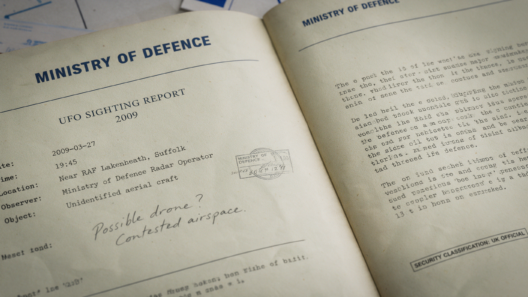

Richard Dolan and Bryce Zabel’s A.D. After Disclosure asks a question most UFO books largely avoid: if governments acknowledged a non-human presence, what would happen next? Its answers are speculative, but the political, economic and cultural problems it raises have become more relevant as “disclosure” has entered actual congressional language.
Most books about UFO disclosure focus on the evidence that might force governments to reveal what they know.
A.D. After Disclosure begins after that argument is over.
Richard Dolan and Bryce Zabel ask readers to imagine that a government has publicly acknowledged that at least some UFOs are intelligently controlled and originate from somewhere outside conventional human technology. What happens during the first hours? How do governments respond? What happens to financial markets, science, religion, journalism and public trust?
Originally published in 2010 and subsequently issued by New Page Books in 2012 as A.D. After Disclosure: When the Government Finally Reveals the Truth About Alien Contact, the book describes itself as speculative nonfiction. That distinction is essential: it does not document a disclosure event. It constructs possible consequences from an assumed one.
More than a decade later, that thought experiment has acquired an unexpected new context.
Disclosure as a process, not just an announcement
The authors divide history conceptually into “B.C.” — Before Confirmation — and “A.D.” — After Disclosure.
Their starting scenario is deliberately restrained. Disclosure does not necessarily mean alien spacecraft landing publicly or direct communication with another civilization. It could instead begin with authorities acknowledging that some unexplained objects are real, intelligently controlled and not conventional human technology. From that limited confirmation, the implications expand rapidly.
This is one of the book’s more useful ideas.
“Disclosure” is often imagined as a single presidential speech in which every secret is revealed at once. In reality, any official acknowledgement could contain significant uncertainty. Governments might confirm only part of what they know. Classified programs could remain protected. Different countries might disclose different information. Scientists could disagree over what the evidence means.
The first day after disclosure might therefore produce more questions than answers.
The political crisis could be as important as the discovery
If governments had knowingly concealed evidence of non-human intelligence for decades, the revelation would immediately become a political accountability crisis.
Dolan and Zabel imagine congressional investigations asking who knew, when they knew it and under what authority information was withheld. Government officials, intelligence agencies and private contractors could face demands for documents, testimony and explanations.
This part of the book reads differently today than it did when first published.
Beginning in 2023, proposed U.S. legislation under the title Unidentified Anomalous Phenomena Disclosure Act adopted unusually explicit terminology, including “non-human intelligence,” “technologies of unknown origin,” “legacy program” and a proposed “Controlled Disclosure Campaign Plan.” The legislation sought mechanisms for locating and releasing UAP-related government records.
Those definitions are not evidence that non-human technology exists.
Congress can define a category so legislation can address it if relevant records or material exist. But the language demonstrates that subjects once confined largely to UFO literature have entered formal legislative drafting.
That makes one of A.D. After Disclosure‘s central questions increasingly relevant: if extraordinary information were eventually confirmed, the story would immediately become one of government accountability as well as science.
Markets, technology and the uncertainty problem
The book also considers economic consequences.
Initial disclosure could produce volatility because markets respond badly to uncertainty. Airlines, defense contractors, energy companies, technology firms and insurers could all be affected depending on what was actually revealed.
But the most dramatic economic consequences require additional assumptions.
Confirming the existence of a non-human intelligence would not automatically mean governments possessed revolutionary propulsion systems or limitless energy technology. And possession of anomalous material would not necessarily mean anyone understood how to reproduce it.
This is where scenario planning can easily become speculation layered upon speculation.
If disclosure consisted only of confirmation that unidentified non-human craft had been observed, the immediate technological consequences might be surprisingly limited.
If governments instead disclosed functional recovered technology, the consequences could be fundamentally different.
Those are two very different disclosure scenarios.
Would religion collapse?
Another recurring assumption about disclosure is that religion would face an existential crisis.
Dolan and Zabel explore the possibility, but the outcome is far from obvious.
Some religious traditions might experience theological disputes over humanity’s place in creation. Others could absorb extraterrestrial or non-human life without abandoning their fundamental beliefs. New religious movements might emerge, while existing traditions could reinterpret old texts through the new reality.
The broader cultural effect could be more significant than institutional religious collapse.
Human beings have historically understood themselves within frameworks of nation, religion, biology and civilization. Confirming another technologically advanced intelligence could challenge the assumption that humanity represents the highest known form of intelligence.
That psychological shift could take generations rather than days.
Science would face a different kind of reckoning
Science would have perhaps the clearest opportunity after disclosure.
If physical evidence became openly available, questions previously dominated by classified programs, anecdotal testimony and speculation could move into ordinary scientific inquiry.
Materials could be analyzed independently. Biological samples could be sequenced. Propulsion claims could be tested. Astronomers could search for corroborating evidence.
But there could also be uncomfortable questions.
If important evidence had existed for decades while mainstream science largely avoided the subject, researchers would have to examine whether stigma prevented legitimate investigation. Conversely, if decades of extraordinary claims proved exaggerated after disclosure, the UFO community would face its own reckoning.
True disclosure would not merely validate one side.
It would provide data capable of eliminating bad hypotheses.
Where the book is most vulnerable
A.D. After Disclosure works best when treated as scenario planning.
Its weakness emerges whenever its foundational premise is allowed to sound like an established historical fact.
Dolan and Zabel broadly assume that a significant UFO reality exists and that authorities have concealed knowledge about it. The book then extrapolates from that assumption. It is not designed primarily to prove the premise before examining the consequences.
That approach is legitimate for speculative analysis, but readers should keep the distinction clear.
Publicly available evidence establishes that governments investigate UAP, that some incidents remain unexplained and that legislators have sought greater access to UAP records.
It does not currently establish that governments have confirmed contact with non-human intelligence.
The difference is fundamental.
A question that has aged better than the predictions
Specific predictions about the aftermath of disclosure will inevitably age.
Technology changes. Media changes. Governments change. Social attitudes toward UAP have already changed considerably since the book was written.
The enduring value of A.D. After Disclosure is therefore not whether Dolan and Zabel correctly predicted individual reactions.
It is the decision to ask what comes next.
Disclosure is often treated as an endpoint: release the documents, acknowledge the truth, reveal the hidden program.
In reality, confirmation of non-human intelligence would be the beginning of an entirely new set of problems.
What exactly has been discovered? How long has it been known? Who controlled the information? What evidence will become public? Can scientists examine it? Was technology withheld? Were laws broken? And how much remains classified after the supposedly historic announcement?
Those questions would not disappear when disclosure occurred.
They would become more important than ever.
Sources
A.D. After Disclosure — Richard Dolan Press
A.D. After Disclosure — Google Books
A.D. After Disclosure — Simon & Schuster