During an ordinary FOX 11 traffic report, a news camera unexpectedly tracked a dark spherical object moving over Los Angeles. The footage does not prove extraordinary technology — but the limited media follow-up raises another question: what would it actually take for UAP to become a serious mainstream news story?
There is something unusual about the latest UAP footage from Los Angeles that has little to do with what the object ultimately turns out to be.
Nobody appears to have been looking for a UFO.
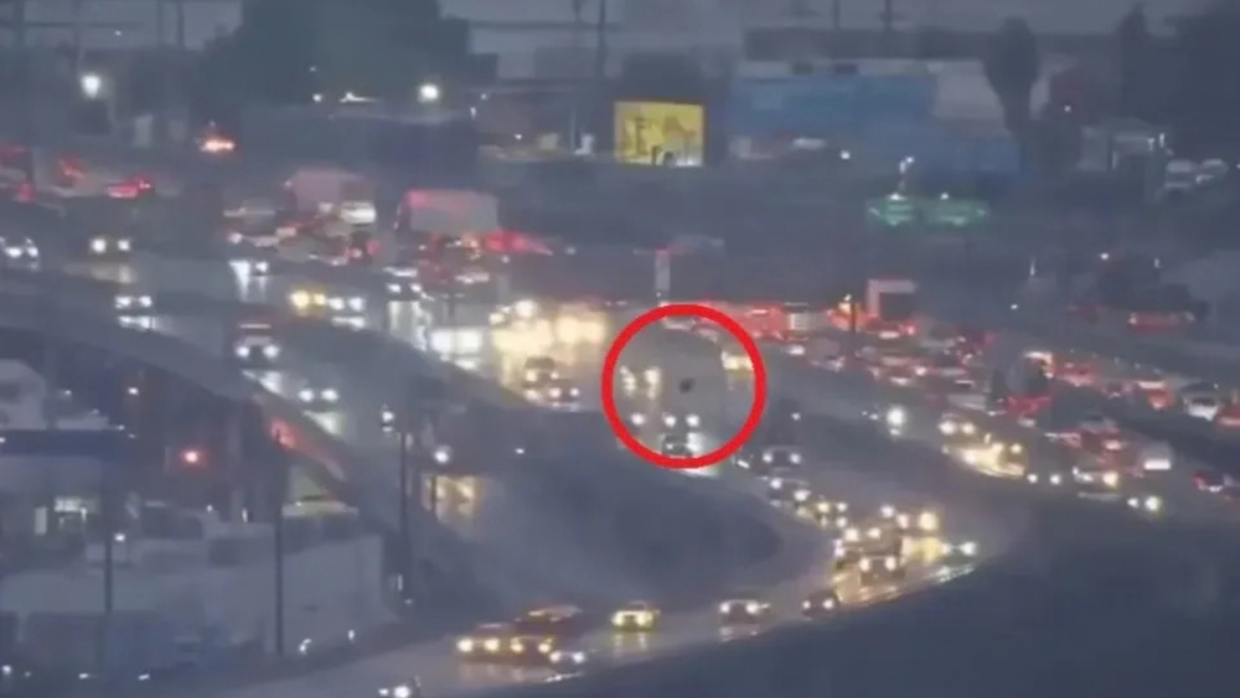
A camera aboard a FOX 11 Los Angeles news helicopter was filming traffic when a small, dark, apparently spherical object entered the scene. The camera operator noticed it, reframed the shot and followed it for several seconds as it travelled away from the freeway.
Then the broadcast moved on.
The clip subsequently spread across social media and was picked up by outlets including The Sun, Yahoo-linked publications, IBTimes and TV Azteca. The US Sun
But there has been remarkably little visible follow-up.
No public identification of the object has emerged. There is no known technical analysis from FOX 11. No second camera angle has surfaced. No corresponding radar information has been published. And the event has not developed into the kind of sustained national news story one might expect if an unidentified object genuinely flew through the field of view of a professional television camera over one of America’s largest cities.
That makes the footage interesting for a reason that extends beyond the object itself.
What, exactly, would it take?
What the footage actually shows
Reports describe the object as dark and approximately spherical, moving on what appears to be a relatively steady trajectory over or near a Los Angeles freeway. FOX 11’s camera operator follows it rather than simply allowing it to pass through the frame. International Business Times UK
The footage was circulating publicly by September 22, 2026. TV Azteca reported that day that it had appeared during a FOX 11 Los Angeles traffic report. Other accounts subsequently described the event as having occurred during a live traffic broadcast. However, UFO Disclosure has not located an archived FOX 11 broadcast establishing the precise recording time, location or original broadcast context. Azteca Morelos
That distinction matters.
Descriptions circulating online have called the object basketball-sized or baseball-sized. Those estimates should not be treated as measurements. Without knowing its distance from the camera, its actual dimensions cannot reliably be determined.
The same applies to speed.
A moving helicopter, a zooming camera and an unknown distance to the object can create dramatic apparent motion. There are no published telemetry data accompanying the clip from which its true velocity can currently be calculated.
There are also no visible wings, rotors or obvious means of propulsion in the available footage. But absence of visible aircraft features in a compressed television image is not evidence that such features were absent from the object itself.
For now, it is simply unidentified.
That is precisely what UAP means.
The balloon explanation cannot simply be dismissed
One obvious possibility is a balloon.
Online discussion has focused particularly on reflective or Mylar balloons, which can look spherical or irregular depending on viewing angle, lighting and image resolution.
That possibility deserves serious consideration.
The Pentagon’s All-domain Anomaly Resolution Office, or AARO, has repeatedly resolved apparently unusual objects as balloons after obtaining sufficient information about their direction and speed. In several published cases, AARO concluded that objects were travelling with prevailing winds — an important clue that they were lighter-than-air objects rather than self-propelled craft. Aaro
In one 2024 Middle East case, for example, AARO assessed with high confidence that a slow-moving spheroidal object recorded by a military platform was a reflective consumer-grade foil balloon after comparing its behaviour with recorded wind speed and direction. Aaro
We currently do not have comparable information for the Los Angeles object.
That means neither conclusion is justified.
Calling it alien would run far beyond the evidence. Declaring it a balloon without the relevant wind, range and trajectory data would do much the same thing in the opposite direction.
The correct answer remains: we do not know.
And that is where the story should have started
The striking aspect of this incident is not that a short video proves something extraordinary.
It does not.
What is striking is the apparent lack of journalistic curiosity that followed.
A professional news-gathering platform appears to have recorded an object its own camera operator considered sufficiently unusual to follow. That should make verification considerably easier than in the typical anonymous smartphone UFO video.
FOX 11 could potentially establish when and where its helicopter was flying. The original recording should contain substantially more image information than compressed social-media copies. Camera specifications may be available. Weather records could establish wind conditions at different altitudes. Flight tracking could help exclude conventional aircraft. Other news, police or traffic cameras may have been operating in the area at the same time.
Those questions do not require believing that the object was extraterrestrial.
They require journalism.
Instead, most of the public discussion has been reduced to the familiar binary: alien spacecraft or balloon.
That is exactly the framing that has damaged serious investigation of UAP for decades.
We may already be seeing what “disclosure” looks like
The context has changed significantly.
The U.S. government now formally collects UAP reports, publishes imagery and releases unresolved cases. In 2026, the Department of War began releasing files through its Presidential Unsealing and Reporting System for UAP Encounters, or PURSUE. War
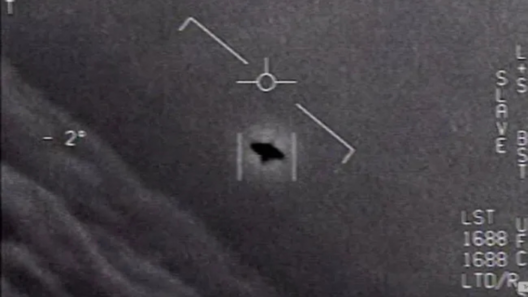
Some government cases even involve objects described as orbs. AARO’s 2023 briefing to the U.S. Senate included imagery of an apparently spherical object recorded by an MQ-9 in the Middle East. The office said its characteristics were consistent with other reports of “metallic orbs,” while also stressing that the object displayed no confirmed anomalous technical capability. Aaro
More recently, government records released in 2026 included an unresolved 2023 case involving federal agents who reported observing what they described as “orbs launching other orbs” near a sensitive national-security site. War
None of that establishes that the Los Angeles object is related to those cases.
But it does establish something else.
“Spherical unidentified objects” are no longer merely a subject of UFO folklore. They are a documented category appearing in official government investigations.
Yet when something visually similar appears during a television news broadcast, the event can still pass through the media cycle almost without investigation.
So what would it take?
Perhaps this is the more important disclosure question.
If an unexplained object appearing unexpectedly on a professional television camera is insufficient, what threshold would trigger serious reporting?
Multiple independent cameras?
Radar confirmation?
Police or military witnesses?
An object performing manoeuvres that clearly rule out wind-driven flight?
Physical material?
Or an official government statement saying that investigators genuinely cannot explain what was observed?
The scientific answer is straightforward: better evidence is necessary. A short video, even one recorded by a professional news camera, cannot by itself establish distance, size, speed, propulsion or origin. AARO has repeatedly stressed that some cases remain unresolved not because they demonstrate extraordinary characteristics, but because investigators lack sufficient range data, altitude, telemetry, sensor information or other context needed to identify them.
That standard should not be lowered.
But there is another problem at work here.
The evidentiary standard for concluding that something extraordinary has occurred is rightly high. The standard for deciding whether something deserves investigation should be much lower.
Those are not the same thing.
A newsroom does not need proof of non-human technology before asking what an unidentified object was. It does not need confirmation from the Pentagon before obtaining the original footage, interviewing the camera operator, checking aviation records, looking at weather conditions or asking whether other cameras captured the same object.
That is ordinary verification.
If the investigation concludes that the object was a balloon, drone, aircraft, bird or some other conventional object, then the story has still produced an answer. If the available evidence remains insufficient, that can be reported honestly as well.
The problem begins when the absence of an immediate extraordinary explanation becomes a reason not to investigate at all.
There is a peculiar paradox surrounding UAP coverage. If a video is blurry, distant or recorded by an anonymous witness, it can easily be dismissed as poor evidence. If an object is recorded by a military sensor, the public is told that classified capabilities may prevent the release of the best data. And when an unidentified object appears during an ordinary television broadcast, apparently captured by a professional camera in broad daylight, it can still disappear from the news cycle before basic questions are answered.
That creates an almost impossible threshold.
The evidence is expected to be extraordinary before the investigation begins, even though investigation is precisely how stronger evidence would be obtained.
Imagine the same reporting standard applied elsewhere. If a television helicopter unexpectedly recorded an unidentified aircraft near an airport, journalists would not normally require proof of espionage before asking aviation authorities what it was. If an unknown object fell from the sky, reporters would not need proof of a dangerous event before trying to identify it. If an unexplained light appeared above critical infrastructure, the absence of an immediate explanation would be part of the reason to investigate, not a reason to abandon the story.
UAP should not receive a lower evidentiary standard than other subjects.
But neither should they be subjected to a uniquely impossible one.
There is also a question of institutional permission.
For decades, UFO stories have largely occupied two media categories: entertainment or ridicule. The subject was acceptable as an unusual closing item on a television broadcast, a viral video or a curiosity accompanied by references to aliens. What remained far less common was treating an unidentified observation as an ordinary investigative question.
That distinction matters.
Serious coverage does not require a journalist to believe that UAP represent extraterrestrial spacecraft, secret technology or anything else extraordinary. It requires only accepting that an unidentified observation can occasionally be worthy of investigation.
The U.S. government has already crossed that conceptual boundary. Congress has held public hearings. The Department of Defense established a permanent office to investigate UAP. Military personnel have been encouraged to report encounters. Government agencies have released imagery, case assessments and annual reports.
Yet much of the wider media culture still appears caught between two older assumptions: either there is an immediate conventional explanation, or the story belongs in the realm of UFO speculation.
There is a large investigative space between those positions.
That space is where journalism should operate.
The Los Angeles footage offers a useful test precisely because it is not spectacular enough to settle anything. There is no visible acceleration that obviously defies conventional flight. There is no known radar confirmation. There are no publicly identified multiple witnesses establishing the object’s distance or size. Based on the currently available evidence, a balloon or another mundane object remains entirely plausible.
But if only spectacular cases deserve investigation, we create a circular problem.
We demand extraordinary evidence before taking the subject seriously, while declining to perform the ordinary investigative work that might determine whether extraordinary evidence exists.
So what would actually change the media response?
Perhaps it would require simultaneous observations from several independent cameras. Perhaps radar and visual confirmation. Perhaps a major aviation incident. Perhaps a close-range event witnessed by hundreds of people. Perhaps clear imagery from multiple sensors showing behaviour that cannot reasonably be reconciled with balloons, drones, aircraft, atmospheric phenomena or sensor artefacts.
Or perhaps none of those things would be enough without institutional confirmation.
That possibility deserves consideration because modern journalism relies heavily on authoritative sources. Reporters routinely seek confirmation from government agencies, police departments, scientific institutions and other recognised authorities before elevating uncertain information into a major story.
For many subjects, that is sensible.
For UAP, however, it produces another paradox. Disclosure concerns the possibility that government institutions may possess information that has not been fully disclosed. If journalists require those same institutions to validate every potentially significant case before investigating it, independent scrutiny becomes difficult by design.
That does not mean official statements should be distrusted automatically.
It means they should be one source of evidence, not the precondition for asking questions.
Perhaps the real threshold for serious UAP coverage therefore should not be “Is this proof?”
It should be something much simpler:
Is there enough here to justify finding out what happened?
In the Los Angeles case, the answer appears to be yes.
That does not mean the object was extraordinary.
It means the event was investigable.
And there is an important difference between the two.
Sources
The Sun — Mysterious orb caught flying over Los Angeles
TV Azteca — FOX 11 Los Angeles UAP footage report
IBTimes — Analysis of the Los Angeles orb footage and competing explanations
AARO — Official UAP imagery and case assessments
Department of War — PURSUE UAP file releases
AARO — 2023 briefing including the Middle East spherical UAP
Department of War — 2026 analysis of the Western U.S. “orbs launching orbs” case