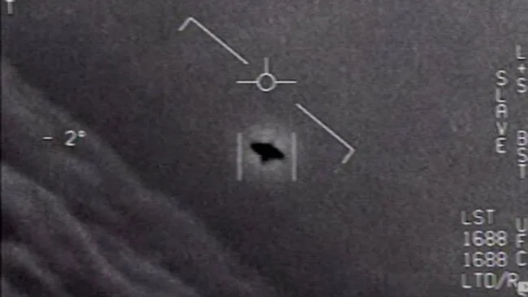

James Lacatski’s fourth and final book on AAWSAP portrays the Pentagon-funded program as an investigation that ranged from advanced aerospace technology to unusual signals, human effects and phenomena at Skinwalker Ranch. The public record confirms that AAWSAP existed and that KONA BLUE grew from it — but major differences remain over what those programs actually established.
James T. Lacatski occupies an unusual position in the modern UAP debate.
Unlike most authors writing about secret government UFO programs, he actually managed one.
Lacatski was the Defense Intelligence Agency official associated with the Advanced Aerospace Weapon System Applications Program, or AAWSAP, a Pentagon-funded effort awarded to Bigelow Aerospace Advanced Space Studies. His 2026 book, Future Visions: Inside the U.S. Government Covert UFO Program, is presented as the fourth and final volume in the series that began with Skinwalkers at the Pentagon. It is also the first of the four books authored by Lacatski alone. The publisher describes it as revealing further technical and investigative details from AAWSAP, including reported UFO “cloaking” capabilities and investigations surrounding Skinwalker Ranch.
Those claims are provocative.
But Future Visions is most useful when read alongside the government documents that now exist independently of the books.
What AAWSAP was officially asked to study
The existence of AAWSAP is not disputed.
A 2008 Defense Intelligence Agency Statement of Objectives shows that the program was intended to examine breakthrough aerospace technologies that could affect the future threat environment through 2050.
The areas listed by DIA were unusually broad: lift, propulsion, power generation, spatial and temporal translation, advanced materials, vehicle configuration, human effects, directed-energy weapons and “signature reduction” across optical, infrared, radio-frequency and acoustic domains. (DIA — AAWSAP Statement of Objectives)
That last category is important when assessing some of the more dramatic language surrounding Future Visions.
Research into “signature reduction” can include technologies designed to make aircraft harder to detect — broadly comparable to stealth or cloaking concepts. The fact that such subjects appeared in AAWSAP’s research mandate does not establish that investigators possessed a UFO capable of becoming invisible.
It establishes that the program was authorized to examine extremely advanced aerospace possibilities.
The DIA has since released numerous associated technical studies through its FOIA reading room, including reports dealing with programmable matter, advanced propulsion, antigravity concepts and biological effects. (DIA — AAWSAP/AATIP records)
Skinwalker Ranch remains central
As with the earlier books, Future Visions portrays AAWSAP as considerably more than a theoretical aerospace study.
Lacatski describes field investigations connected with Skinwalker Ranch in Utah, then owned by businessman Robert Bigelow, whose company held the AAWSAP contract.
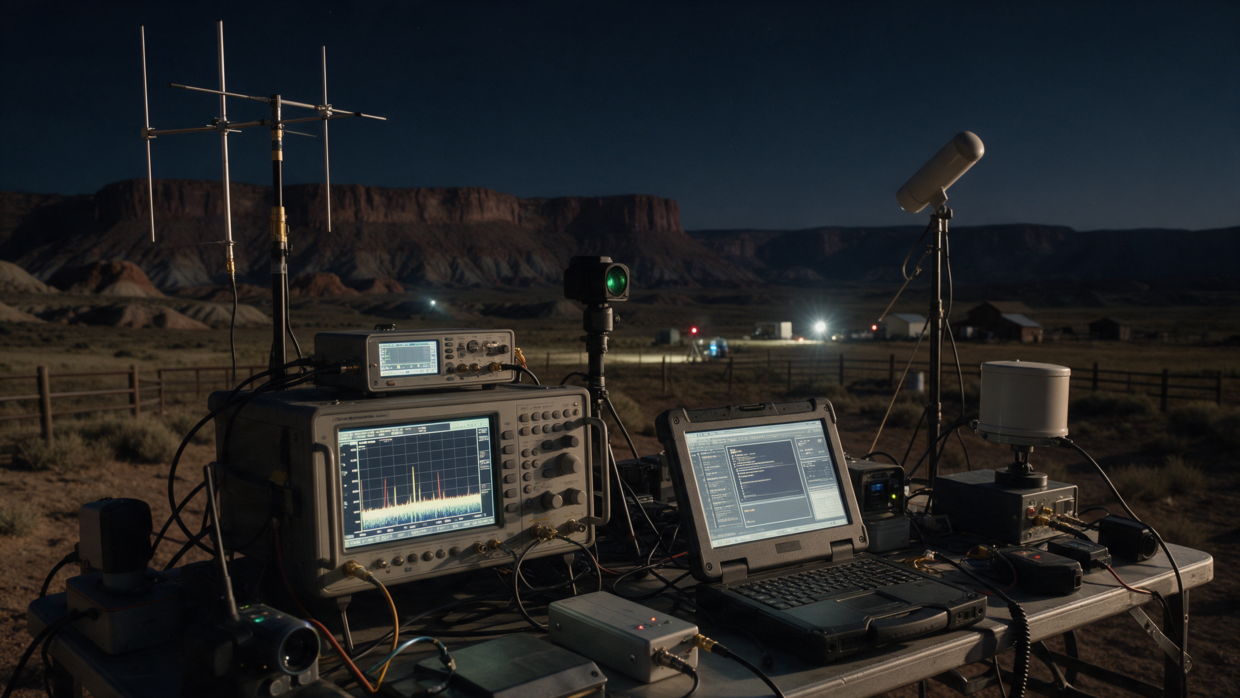
In an April 2026 appearance on Weaponized, Lacatski discussed material from the new book concerning intermittent electromagnetic signals detected during investigations at the ranch. He also described security concerns and efforts to determine whether outside human actors might have been interfering with the project.
The existence of measurements does not settle their origin.
Radio-frequency environments can contain terrestrial communications, satellites, instrumentation effects and interference. A signal recorded during an investigation becomes evidence that something was measured, not automatically evidence of an anomalous intelligence.
That distinction applies to much of the Skinwalker material.
AAWSAP investigators clearly took reported events seriously enough to devote personnel, equipment and government-funded contractor resources to studying them. Whether the resulting observations demonstrate a previously unknown phenomenon remains a separate question.
Lacatski does not claim to know what the phenomenon is
One of the more interesting aspects of Lacatski’s 2026 interviews is how far he stops short of a final explanation.
When asked whether he or anyone else in government knew the answers to questions such as who or what was behind the phenomenon, Lacatski said he did not and that he would seriously question anyone claiming otherwise.
He characterized the subject as still “wide open” and suggested that government knowledge of the ultimate explanation may be considerably more limited than many disclosure narratives assume.
That complicates a common interpretation of the AAWSAP books.
Future Visions does not present a former program manager saying that the government solved the UFO mystery and knows precisely who is responsible.
Instead, Lacatski presents AAWSAP as having accumulated observations and investigations that he believes deserve continued study without claiming a complete theory explaining them.
The KONA BLUE disagreement
The book’s most consequential institutional claim concerns what happened after AAWSAP.
Lacatski argues that AAWSAP effectively transitioned into the proposed Department of Homeland Security effort known as KONA BLUE. In his Weaponized interview, he said the public KONA BLUE material released by the government was accurate but “incomplete.” The discussion also referenced his assertion in Future Visions that AAWSAP “converted to KONA BLUE.”
There is an important area of agreement here.
The Pentagon’s All-domain Anomaly Resolution Office also says KONA BLUE originated directly from people associated with AAWSAP. According to AARO, the proposed program was intended to continue investigations into sensitive materials and advanced aerospace technologies after DIA ended AAWSAP. (AARO — History and Origin of KONA BLUE)
But the official account sharply limits what happened next.
AARO says KONA BLUE remained a prospective Special Access Program, was ultimately rejected by senior DHS leadership, received no operational funding and never obtained any material. It also states that no data or physical material was transferred to DHS under the program.
The public record therefore supports a direct lineage from AAWSAP to KONA BLUE.
It does not currently demonstrate that KONA BLUE became the operational continuation Lacatski’s language can appear to imply.
That discrepancy deserves further documentation rather than assumption.
What Future Visions leaves behind
Taken together, Lacatski’s four books create one of the most detailed insider narratives available about AAWSAP.
They are important because the author was not observing the program from outside. He was involved in managing it and says the books were constructed from material connected to the program’s files.
But government prepublication clearance should not be confused with government endorsement. Permission to publish generally establishes that officials determined the released material did not improperly disclose protected classified information. It does not certify every interpretation or conclusion as true.
That leaves Future Visions in an unusual evidentiary position.
AAWSAP unquestionably existed. Its contract documents show an extraordinary research mandate. KONA BLUE unquestionably emerged from people associated with the program. And government archives confirm that many of the institutional structures described in this story were real.
The harder claims remain harder.
Did AAWSAP encounter phenomena that cannot be explained conventionally? Were unusual signals or biological effects connected to UAP? Did any successor effort continue beyond the publicly documented KONA BLUE proposal? And did anyone ever obtain the material the proposed program was designed to analyze?
Future Visions offers Lacatski’s answer to parts of that story.
Full disclosure would require the underlying records.
Sources
James T. Lacatski — Future Visions, Google Books
Defense Intelligence Agency — AAWSAP/AATIP FOIA Reading Room
DIA — AAWSAP Statement of Objectives
AARO — History and Origin of KONA BLUE
Weaponized — Dr. James Lacatski: This Is UFO Disclosure, As Far As It Can Go