Five batches of UAP records released since May bring historical intelligence files, military sensor footage, NASA material and recent unresolved cases into one public archive — but “unresolved” remains a description of the evidence gap, not an explanation.
The U.S. government has quietly built one of its largest centralized public collections of UFO and unidentified anomalous phenomena records.
Between May 8 and August 7, 2026, the Pentagon released five separate tranches through the Presidential Unsealing and Reporting System for UAP Encounters, or PURSUE. The archive brings together documents, imagery, audio and video from agencies including the Department of War, FBI, CIA, NASA, Department of Energy, State Department and Office of the Director of National Intelligence.
As of September 6, the fifth tranche remains the latest official release, although the Pentagon says further material is being prepared.
A rolling disclosure program
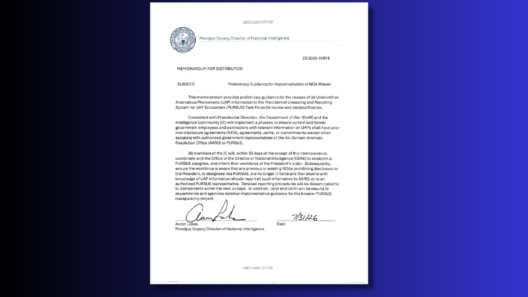
PURSUE followed a February 19, 2026 presidential directive calling on federal departments and agencies to identify and release government files concerning UFOs, UAP and alleged extraterrestrial life.
The Pentagon says the program involves coordination across dozens of agencies and potentially the review of tens of millions of records, some existing only on paper. Rather than waiting for that process to conclude, records are being released in successive batches as they are located, reviewed and cleared.
The first tranche appeared on May 8. Further releases followed on May 22, June 12, July 10 and August 7. The official portal currently offers downloadable packages ranging from hundreds of megabytes to several gigabytes. Release 2 alone includes a video package listed at 5.6 GB, while Release 3 contains another 4.6 GB of video.
That matters because PURSUE is not simply another collection of scanned Cold War UFO correspondence. It mixes historical records with relatively recent sensor footage and contemporary investigative material.
From Project Sign to modern military encounters
The historical side of the archive reaches back to the early post-war UFO era.
Release 4, for example, includes a 1949 Department of Energy record concerning a Los Alamos conference on aerial phenomena and a 1948 Project Sign progress report. Project Sign was an early U.S. Air Force investigation of reports then commonly described as “flying discs.”
Other records extend the geographical scope well beyond the United States. State Department material in the database includes reports associated with Papua New Guinea, Kazakhstan, Georgia, Turkmenistan and Mexico, while the August release added diplomatic cables concerning reported phenomena in Brazil in 1963.
NASA material covers another period entirely. The archive contains Apollo-era transcripts, audio and imagery, including Apollo 12 material from 1969. Release 4 also added three images associated with Space Shuttle mission STS-80 in 1996, catalogued as images of an unidentified object in low-Earth orbit.
Their inclusion in a UAP archive should not itself be interpreted as evidence that NASA determined the objects to be extraordinary. The records document observations or material selected for review; that is a different evidentiary standard.
Recent military footage is part of the archive
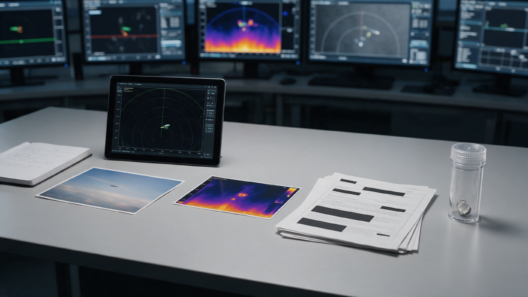
More recent cases may ultimately be the most useful material for researchers because some originate from modern military sensors.
The May 22 tranche includes two Department of War videos catalogued as “USCG C-144 Tyndall UAP” recordings from April 24, 2024. Their official filenames use the description “TIC TAC IR hot.” The existence and government release of the recordings are documented; the filename does not establish what the objects were.
Other entries include unresolved reports from the East China Sea, Japan and the wider Indo-Pacific region, as well as a 2025 ODNI record involving a senior U.S. intelligence-community official.
Release 4 added unresolved military video cases from the Yellow Sea and East China Sea dated 2025. Release 5 then introduced material ranging from a CIA report of a 1965 UFO observation near Puerto Rico to FBI records involving triangular objects and reports of multiple red lights in the western United States during 2026.
Several of the FBI entries are explicitly identified as digital renderings. That distinction is important: a reconstruction based on a witness account is not equivalent to a photograph of the reported phenomenon.
What “unresolved” actually means
The most consequential wording on the PURSUE portal may be its definition of the archive itself.
The Pentagon describes the material as unresolved because the government has been unable to make a definitive determination about the observed phenomenon. It explicitly acknowledges that insufficient data can be one reason a case remains unresolved.
That prevents a common but significant logical leap.
An unresolved UAP is not automatically evidence of an unknown technology, and it is certainly not proof of extraterrestrial origin. A case may remain open because imagery is too poor, contextual information is unavailable, sensor data are incomplete or competing explanations cannot be tested.
The Pentagon also stated when the first tranche was released that although the files had undergone security review, many had not yet been fully analyzed to resolve the anomalies they contained.
Declassification therefore establishes public access to a government record. It does not authenticate every allegation recorded inside it.
Why PURSUE matters for disclosure
The significance of PURSUE lies less in any single spectacular document than in the structure of the release.
Records previously distributed across different agencies, archives and classification systems are being gathered into a searchable public repository. Researchers can compare historical reports with modern cases, examine how different agencies recorded UAP incidents and scrutinize original material without relying solely on second-hand descriptions.
There are still substantial unanswered questions. It is not yet clear how complete the archive will become, what material remains classified, how agencies decide which records qualify for PURSUE, or whether higher-quality sensor data exist behind some of the publicly released cases.
Those are disclosure questions in the literal sense: questions about what records exist, how they were handled and how much of the underlying evidence the public is ultimately permitted to examine.
For now, PURSUE provides considerably more source material with which to ask them.