
Astronomical plates from the 1950s contain brief, star-like sources that appear once and then vanish. Because some were recorded years before Sputnik, ordinary satellite glints cannot explain them — but neither do the observations establish that artificial objects were orbiting Earth.
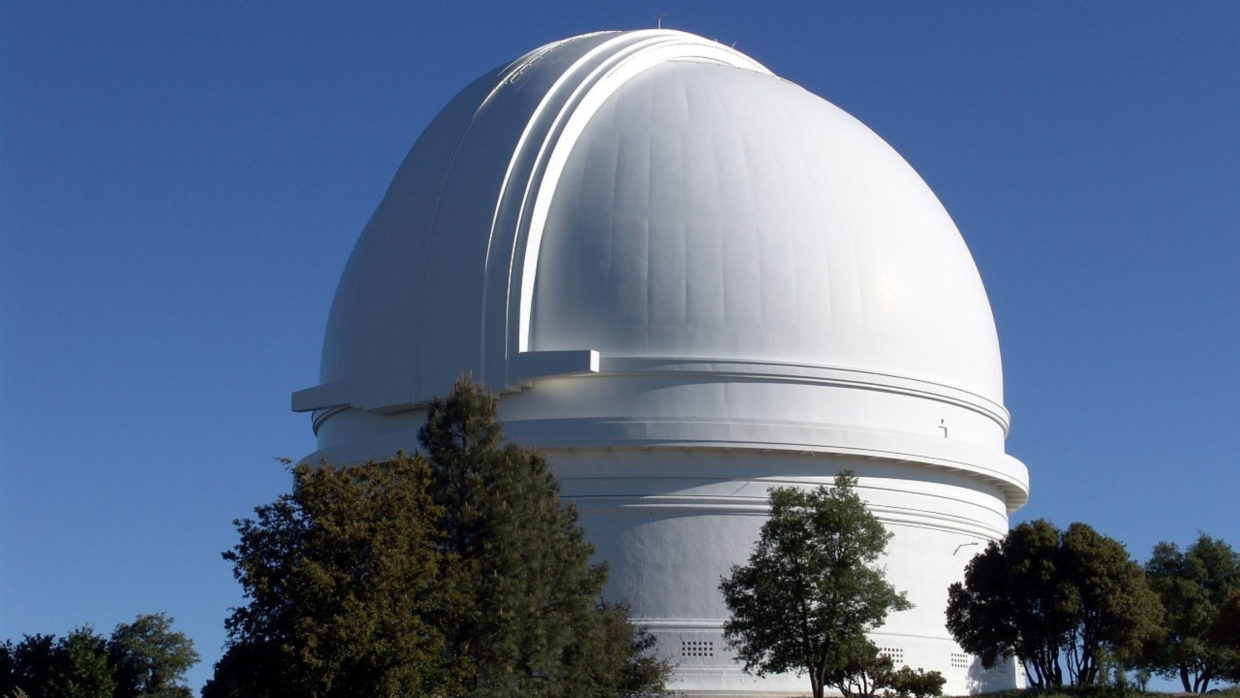
On April 12, 1950, astronomers at Palomar Observatory in California exposed a photographic plate of the night sky as part of the first Palomar Observatory Sky Survey.
Decades later, researchers examining digitized versions of that plate found something unusual: nine point-like sources clustered inside a region only about ten arcminutes across. They appeared on the red-sensitive plate, but were absent from a blue exposure taken roughly half an hour earlier, from another red plate six days later and from much deeper modern observations of the same region.
The objects have never been satisfactorily identified.
That alone would make them an astronomical curiosity.
Their date makes them considerably more interesting.
The Soviet Union did not launch Sputnik 1 — the world’s first artificial satellite — until October 4, 1957, more than seven years later.
If the points on the Palomar plate represent real flashes in the sky rather than defects or contamination on the photographic material, one of the most obvious modern explanations for such flashes apparently should not have existed yet.
A photographic record from before the space age
The National Geographic Society–Palomar Observatory Sky Survey, now known as POSS-I, was conducted between 1949 and 1958 with Palomar’s 48-inch Schmidt telescope, today called the Samuel Oschin Telescope.
Its purpose was not to look for UFOs or artificial objects. It systematically photographed large areas of the sky on glass plates in red and blue wavelengths, creating a reference survey that became widely used by astronomers.
That history gives the plates an unusual scientific value today.
Modern astronomical images are filled with human-made objects. Satellites, rocket bodies and debris can all reflect sunlight. A rotating satellite can create a very brief specular reflection, or glint, that appears point-like on a long astronomical exposure.
For modern observations, satellite glints must therefore be considered whenever an unexplained short-duration point source appears.
Pre-Sputnik plates remove that particular explanation — at least if the accepted history of human spaceflight is correct.
That does not tell us what the transients are. It simply makes the historical dataset unusually clean.
Nine objects that were not there before or after
Beatriz Villarroel and colleagues published their analysis of the April 1950 event in the peer-reviewed journal Scientific Reports in 2021.
The nine sources appeared on plate XE 325. Eight looked star-like, while one showed possible elongation. Modern observations with the 10.4-meter Gran Telescopio Canarias detected faint objects near some of the historical positions, but the researchers found that chance alignment could not be ruled out. There is therefore no demonstrated persistent astronomical source corresponding to the original flashes.
The researchers considered several conventional astronomical possibilities.
Known fast transients such as stellar flares and gamma-ray-burst counterparts occur far too infrequently to comfortably explain nine events appearing within such a small region during the same exposure. Asteroids and meteors should generally produce motion or streaking rather than isolated star-like points under the conditions examined by the authors.
That left two broad possibilities deserving further attention.
Either the plate contains an unusual form of contamination or defect that mimics stars remarkably well, or the telescope recorded real, extremely short flashes in the sky.
The photographic-plate problem
The first possibility cannot be treated as a minor objection.
Photographic astronomy involved physical emulsions, glass plates, chemical development and later digitization. All of those processes can introduce artifacts.
The 2021 paper examined scanning artifacts, optical effects, elementary particles, radioactive contamination, moisture and several possible human sources of contamination. Some explanations were considered inconsistent with the shape or distribution of the sources, but the researchers could not exclude an unknown plate-related effect.
This is one reason the word transient must be used carefully.
A transient candidate in a digitized astronomical archive is not automatically an object that existed in the sky. Establishing that distinction is part of the research itself.
The original study noted that microscopic examination of the physical plates could help distinguish genuine optical images from defects in the emulsion. At the time of that paper, the researchers did not have access to the original POSS-I plates for such examination.
For the UAP debate, this limitation is crucial. A mysterious feature in historical data becomes relevant only after mundane causes have been tested as rigorously as possible.
The orbital-reflection hypothesis
The more provocative possibility arises because the Palomar points resemble a phenomenon astronomers understand very well today.
Rotating artificial objects in high orbit can briefly reflect sunlight toward an observer. If the flash lasts for only a fraction of a second during a long exposure, it can appear as a stationary point rather than a streak.
The 2021 team calculated that an object near geosynchronous orbit producing a flash shorter than about half a second could create a point-like image consistent with the observations. The authors explicitly presented this as a hypothetical scenario, not an identification.
The obvious difficulty is historical.
There are no acknowledged human-made satellites from 1950.
That gap is the reason the Palomar observations occasionally enter discussions about possible technosignatures or UAP. But moving from “a satellite-like reflection could reproduce the appearance” to “artificial objects existed before Sputnik” would be an enormous evidentiary leap.
The current data do not justify it.
Later research has kept the question open
The original paper suggested searching for multiple flashes arranged in lines, because a rotating reflective object moving across the field might produce that pattern.
Researchers subsequently did exactly that.
A peer-reviewed 2025 study in Publications of the Astronomical Society of the Pacific reported several groups of point-like Palomar transients aligned along narrow bands. The authors again concluded that the phenomenon remained unresolved and emphasized that unknown plate contamination or emulsion defects had not been eliminated.
Research has continued in 2026.
A separate preliminary study of plates from Hamburg Observatory reported similar short-lived sources in a different historical archive. That work is currently a preprint rather than peer-reviewed confirmation, but independent archival replication is important because it could eventually help determine whether the phenomenon is specific to Palomar’s plates or genuinely astronomical.
Most recently, Villarroel and colleagues posted a September 2026 modelling preprint exploring what the Palomar events would imply if they are specular reflections. Under the model’s assumptions, the observed distribution was consistent with reflecting objects at characteristic altitudes of roughly 20,000–35,000 kilometres. The paper explores both natural and non-natural models and does not identify the objects.
Because that study has not yet undergone peer review, its conclusions should be treated as provisional.
Why this matters to disclosure
The Palomar research differs from most UAP cases in one important respect.
It does not begin with a witness reporting something unusual.
It begins with a physical astronomical record created for an entirely different scientific purpose decades ago.
That makes the evidence potentially testable. Researchers can inspect the plates, compare independent scans, search other observatory archives, model possible optical effects and attempt to reproduce the statistical patterns.
The result may eventually be mundane.
Photographic defects could explain the observations. A poorly understood natural phenomenon could be responsible. Further research may show that assumptions behind the orbital interpretation were incorrect.
But if independent work were eventually to demonstrate that the sources were genuine sub-second reflections from objects near Earth, the pre-Sputnik dates would become extremely difficult to explain within the conventional history of spaceflight.
We are not there yet.
For now, the Palomar transients are scientifically interesting precisely because the answer remains unresolved — and because, unlike many extraordinary UAP claims, the underlying data can continue to be tested.
Sources
Villarroel et al. — Aligned, Multiple-transient Events in the First Palomar Sky Survey, PASP
Caltech — The Samuel Oschin Telescope and POSS-I
NASA — Sputnik and the Dawn of the Space Age
Busko — Searching for Fast Astronomical Transients in Archival Photographic Plates
Villarroel et al. — Modelling Palomar Transients, September 2026 preprint