
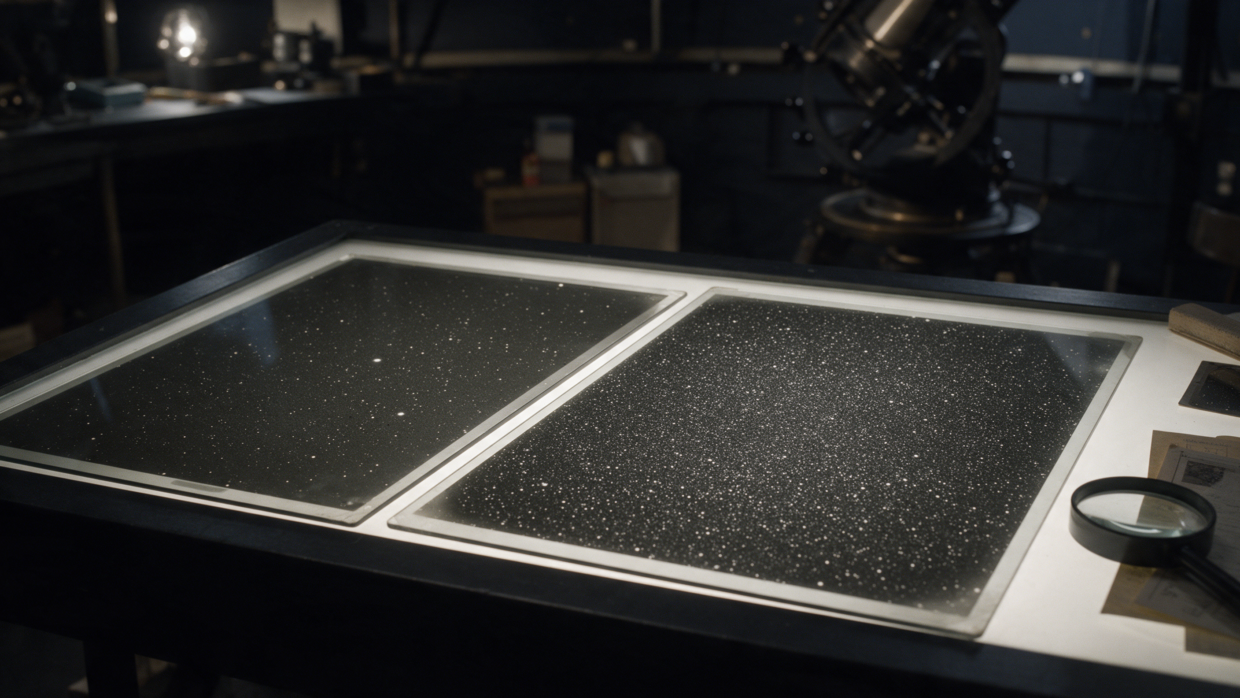
By comparing astronomical photographs from before the space age with the modern sky, astronomer Beatriz Villarroel and the VASCO project are investigating brief points of light that appear once and then vanish. Most may have conventional explanations. A smaller group remains difficult to account for.
Astronomy is usually about looking farther into space. Beatriz Villarroel has taken a different approach: looking backward in time.
At the Vanishing & Appearing Sources during a Century of Observations project — VASCO — Villarroel and an international team of researchers compare historical photographs of the night sky with later observations. Their objective is to identify sources of light that appeared in old astronomical images but cannot be found again.
The project began as a search for unusual astrophysical phenomena. It has since developed into something broader, including the possibility that some short-lived flashes might originate much closer to Earth.
That possibility is especially intriguing because some of the photographs were taken before humanity had placed a single known satellite in orbit.
Searching a sky that no longer exists
Villarroel is an astronomer at the Nordic Institute for Theoretical Physics, Nordita, in Stockholm, where her research includes astronomical data analysis and searches for unusual transient phenomena. She leads both VASCO and the more recent EXOPROBE project.
VASCO’s original concept is straightforward.
Take observations made decades ago, compare them with much deeper modern sky surveys, and look for objects that were once visible but have disappeared.
The first major VASCO study compared around 600 million sources from the U.S. Naval Observatory’s USNO-B1.0 catalogue with the Pan-STARRS modern sky survey. Researchers initially identified roughly 150,000 objects without an obvious Pan-STARRS counterpart. After further filtering and visual inspection of about 24,000 candidates, the team reported approximately 100 point-like sources that appeared in only one historical red exposure.
That does not mean VASCO discovered 100 stars that mysteriously ceased to exist.
The researchers themselves emphasize this distinction. Many candidates are more likely to be short-lived transients — temporary astronomical events that briefly become bright enough to appear on a photograph and then fade. Possible natural explanations include stellar flares and distant supernovae. VASCO reports that it has not identified a confirmed failed supernova or Dyson sphere among its vanishing-star candidates.
The interesting question is what remains after ordinary explanations and photographic errors are considered.
The advantage of looking before Sputnik
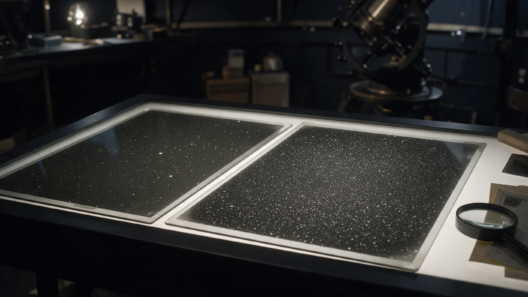
One particular archive gives the research an unusual advantage: the First Palomar Observatory Sky Survey, or POSS-I.
Beginning around 1949, the survey photographed large areas of the sky using glass photographic plates. Several years later, on October 4, 1957, the Soviet Union launched Sputnik 1, the first confirmed human-made satellite.
That dividing line matters.
Modern astronomical images routinely contain brief flashes caused by sunlight reflecting from satellites and space debris. An object rotating in orbit can act like a mirror for a fraction of a second, creating a point-like flash on an astronomical exposure.
But conventional satellites cannot explain a photograph taken in 1950.
That does not make an unexplained pre-Sputnik light source non-human technology. It removes one explanation while leaving numerous others, including photographic defects, contamination, cosmic-ray effects and poorly understood astrophysical phenomena.
VASCO’s research has increasingly focused on distinguishing between those possibilities.
Nine lights on one photograph
One of the project’s most unusual cases was published in the peer-reviewed journal Scientific Reports in June 2021.
On a red-sensitive Palomar plate exposed on April 12, 1950, Villarroel and colleagues identified nine star-like sources clustered within an area approximately ten arcminutes across.
They were not visible on earlier or later observations.
A blue-sensitive exposure of the same region taken approximately half an hour earlier did not show them. Another red exposure six days later did not show them either. Modern observations using the 10.4-meter Gran Telescopio Canarias also failed to establish persistent objects corresponding clearly to the nine sources.
The authors examined known categories of transient astronomical events but found that their expected occurrence rates did not readily explain nine sources appearing together.
Their paper did not conclude that artificial objects had been photographed.
Instead, it identified a significant unresolved problem: contamination or an unknown plate-related effect remained possible. But the authors also proposed that, if photographic contamination could eventually be excluded, very brief reflections from reflective objects near geosynchronous orbit could produce similar appearances.
For a photograph taken seven years before Sputnik, that hypothetical explanation raises an obvious question: reflective objects belonging to whom?
At present, the data do not answer it.
The search becomes more provocative
Subsequent research has made the issue harder to dismiss, but not necessarily easier to explain.
In October 2025, Villarroel and colleagues published a peer-reviewed study looking specifically for multiple transients aligned along narrow bands on Palomar plates. Such alignments are interesting because a rotating reflective object moving through space could potentially generate a sequence of brief flashes along its path.
The researchers produced a shortlist of candidate alignments and found an unexpected deficit of transient events in areas where objects at geosynchronous distance would have been inside Earth’s shadow — where sunlight could not produce reflections.
Yet the study again stopped short of identifying artificial objects. The authors explicitly noted that rare optical effects, including ghost images, could not yet be completely excluded and described the research as an initial exploration requiring more systematic testing.
Another peer-reviewed study published three days later examined more than 100,000 Palomar transients and reported statistical associations with atmospheric nuclear tests and historical UAP reports. The researchers themselves described the hypotheses as speculative and cautioned that statistical association does not establish what the transients were or prove a causal relationship.
Those findings deserve separate examination because their implications — and methodological limitations — are substantial.
New tests are continuing in 2026
The central criticism of the VASCO results remains straightforward: old photographic plates are imperfect instruments.
A defect on photographic emulsion can look remarkably like a real astronomical source after digitization. Establishing that a point of light is genuine is therefore essential before asking what created it.
Researchers have begun testing that problem more directly.
An April 2026 preprint involving Villarroel used machine learning trained on visually classified examples to distinguish likely transients from plate defects across a dataset of more than 100,000 candidates. The authors reported that several previously observed statistical patterns remained after the automated filtering.
Separately, a March 2026 preprint reported a search using historical plates from Hamburg Observatory rather than Palomar. Its author reported transient candidates with some characteristics resembling the VASCO observations.
Both results are important avenues for replication. But both are preprints and had not undergone the same peer-review process as the published VASCO papers at the time of writing. They should therefore be treated as developing evidence, not established findings.
What has actually been discovered?
There is a temptation to reduce Villarroel’s research to a dramatic claim: objects were orbiting Earth before Sputnik.
The published evidence does not establish that.
What it does establish is more precise.
Historical astronomical plates contain short-lived, star-like sources. Some occur in unusual groups. Researchers have identified patterns that they argue are difficult to reconcile with several conventional explanations. At the same time, instrumental effects and photographic artifacts have not been comprehensively eliminated for every candidate.
The origin of the most interesting transients therefore remains unknown.
That uncertainty is exactly what makes the research relevant to disclosure.
Instead of beginning with witness testimony and trying to determine what someone saw decades ago, VASCO begins with preserved astronomical data. The original photographic plates existed before the current UAP debate, and the anomalies can be examined using methods available to other researchers.
If the phenomena ultimately prove mundane, that result matters.
If they represent a previously unknown natural phenomenon, that matters too.
And if increasingly rigorous studies were eventually to demonstrate that reflective artificial objects existed around Earth before humanity’s acknowledged space age, the implications would be difficult to overstate.
VASCO has not reached that conclusion.
But it has developed a way to test the question.
Sources
VASCO Project — Official Website
Villarroel et al. — Aligned, Multiple-transient Events in the First Palomar Sky Survey, PASP