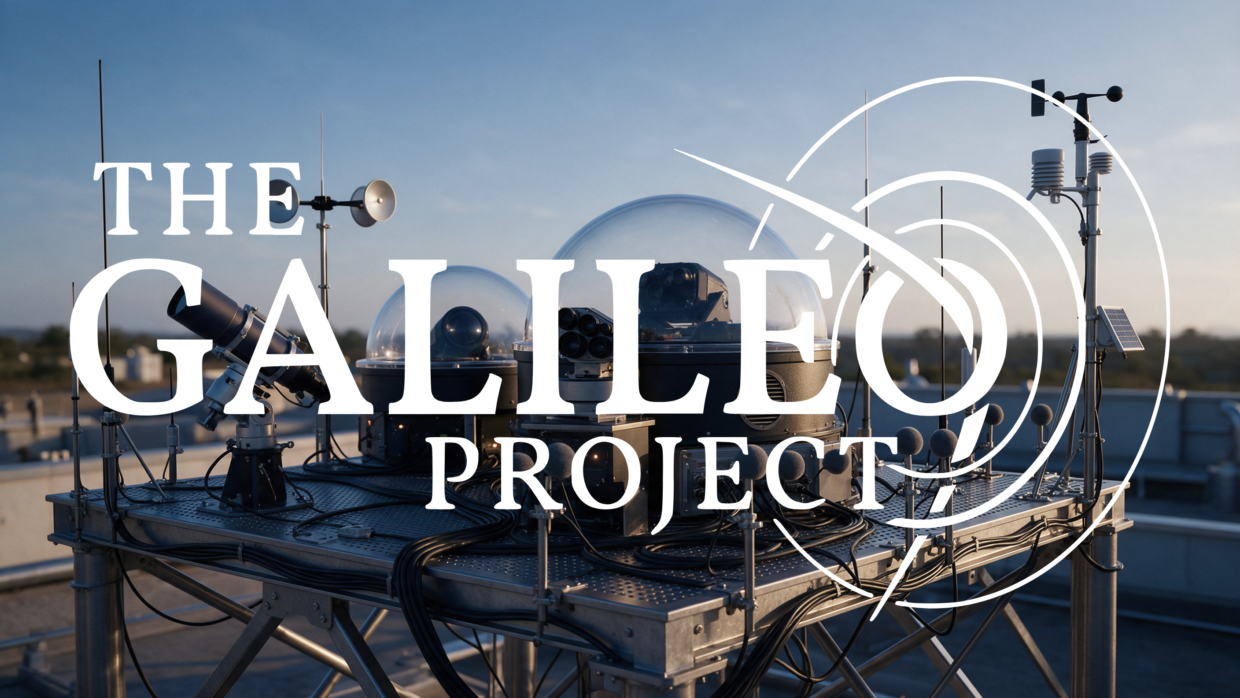
The Harvard-hosted research initiative is building ground-based observatories that combine cameras, infrared imaging, radar, acoustics and environmental sensors. Its aim is to replace isolated sightings with measurements that can be tested.
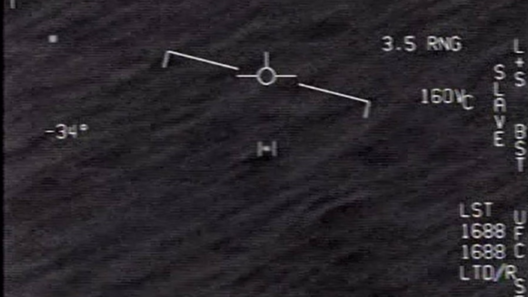
Most UAP evidence was not collected for scientific research. A pilot may see an unfamiliar object, a military sensor may record a short video, or a witness may capture a distant light on a phone. The observation can be genuine while still lacking the distance, calibration and context needed to determine what happened.
The Galileo Project is attempting a different approach: instruments designed in advance to monitor the sky, document ordinary aerial activity and identify events that do not fit the resulting baseline.
A civilian search built around new observations
Launched in 2021 and led by Harvard astrophysicist Avi Loeb, the Galileo Project is a privately funded, cross-institutional research initiative hosted at Harvard University. Its broader goal is to search scientifically for physical evidence of extraterrestrial technological civilizations. Its UAP branch tests whether systematic observation can determine the nature of unusual objects in or near Earth’s atmosphere. The Galileo Project’s stated goal.
That goal is a research hypothesis, not a conclusion that UAP are extraterrestrial. The project says it limits its analysis to explanations consistent with known physics. It also avoids retrospective analysis of existing photographs, radar records and anecdotal cases, concentrating instead on data collected by its own calibrated equipment. The project’s defined research scope.
One event, multiple instruments
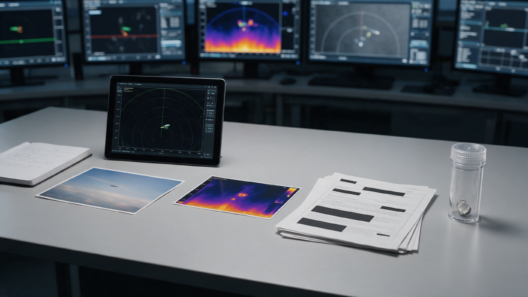
The project’s observatory design is multimodal: several different kinds of sensors monitor the same volume of sky. A 2023 paper in the Journal of Astronomical Instrumentation describes six principal components:
- wide-field optical and infrared cameras for detection and tracking;
- narrow-field cameras for detailed images and spectral measurements;
- passive radar for range, position and velocity;
- radio receivers for measuring radio and microwave emissions;
- microphones covering infrasonic through ultrasonic frequencies; and
- environmental instruments recording weather and electric or magnetic conditions.
Multiple observations can address weaknesses in a single video. Cameras placed at known locations can help triangulate distance. Once distance is known, estimates of size, speed and acceleration become more meaningful. Radar can provide an independent measurement of motion, while environmental sensors can test whether weather or atmospheric conditions contributed to an apparent anomaly.
Corroboration also helps expose instrumental effects. A feature present in one camera but absent from the other sensors may originate in the camera, its optics or its processing rather than in a physical object. The project’s multimodal observatory paper.
First learn what the ordinary sky looks like
The observatories are intended to conduct a continuing census of aerial activity. Software must classify aircraft, satellites, drones, balloons, birds, meteors and other familiar phenomena before researchers can isolate credible outliers.
This makes calibration and baseline data central to the experiment. The system’s performance must be measured against objects whose positions are already known, and its detection limits must be documented under different ranges and weather conditions. Machine-learning tools can assist with classification, but an event rejected by a model is not automatically extraordinary. It is simply a candidate requiring further examination.
The project says its intended outputs include raw, calibrated and interpreted data, along with peer-reviewed descriptions of its instruments, validation methods and evidential standards. Its FAQ states that data are to be released after commissioning and labeling rather than streamed live. Galileo Project FAQ.
What the infrared system recorded
A 2025 paper in the journal Sensors documented the commissioning of an array using eight long-wave infrared cameras. The researchers calibrated the system partly by comparing detections with aircraft positions broadcast through Automatic Dependent Surveillance–Broadcast, or ADS-B.
During five months of field operation, the system reconstructed approximately 500,000 aerial trajectories. An experimental search based on unusually winding two-dimensional paths initially flagged about 16 percent as outliers. Manual review reduced that group to 144 ambiguous trajectories.
The authors did not present those 144 tracks as evidence of exotic technology. They wrote that the objects were probably mundane but could not yet be resolved without distance and kinematic estimates or information from additional sensor types. The result demonstrates both the potential and the limitation of automated anomaly detection: an outlier is a prompt for investigation, not an identification. The peer-reviewed infrared-array commissioning paper.
What would count as progress?
The Galileo Project has published a detailed measurement strategy and evidence that part of its sensor system has operated at scale. That is different from demonstrating that it has detected a genuinely anomalous object.
Its scientific value will depend on whether the full system produces synchronized measurements, whether calibration and selection effects are documented, and whether data and analytical methods become accessible enough for independent researchers to test the conclusions. An unexplained track with inadequate information would reproduce the problem the project was created to solve.
For disclosure, the project offers a useful model: collect evidence openly, publish the instrument limitations and let competing explanations be tested. If that process identifies aircraft or sensor artifacts, it has worked. If a well-measured event remains outside established categories, researchers will have a stronger case for further investigation.
The important change is not a new claim about what UAP are. It is an attempt to build the kind of evidence that could eventually answer the question.