A July 31 intelligence memorandum orders U.S. agencies to remove secrecy-agreement barriers when personnel report UAP information through authorized channels. Avi Loeb calls the change decisive, but the document does not authorize public leaks or establish that non-human technology exists.
An unclassified U.S. intelligence memorandum instructs agencies to ensure that current and former government personnel and contractors can report information about unidentified anomalous phenomena without being blocked by previous nondisclosure agreements.
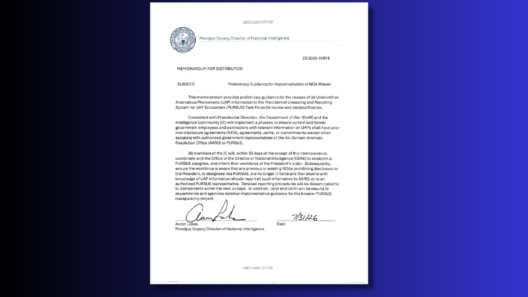
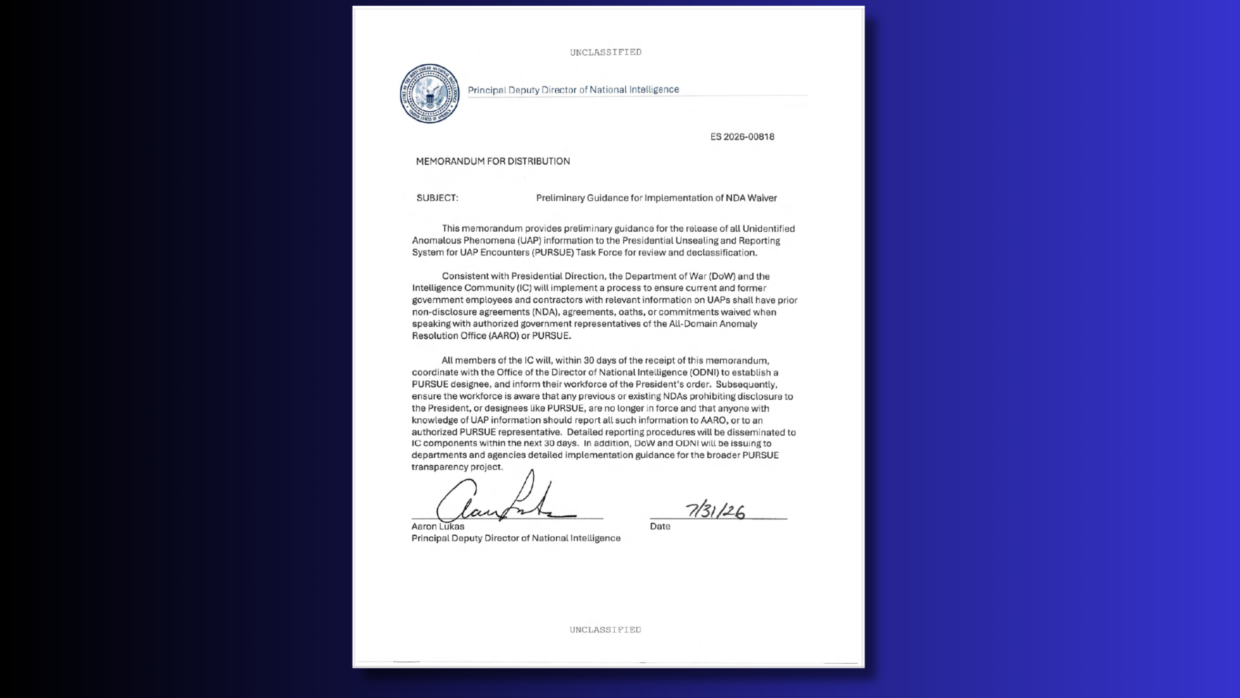
The two-page document, marked unclassified and dated July 31, 2026, was signed by Principal Deputy Director of National Intelligence Aaron Lukas. Representative Eric Burlison published the memorandum on August 1, saying the Trump administration had authorized his office to distribute it publicly.
The measure could make it harder to prevent information from reaching designated investigators. Its scope, however, is narrower than a general release from classification rules: it protects reporting to authorized government representatives, not disclosure to journalists or the public.
What the memorandum requires
The document, identified as ES 2026-00818 and titled “Preliminary Guidance for Implementation of NDA Waiver,” directs the Department of War and the Intelligence Community to create a process covering UAP information submitted to the Presidential Unsealing and Reporting System for UAP Encounters (PURSUE).
It states that prior NDAs, agreements, oaths or commitments are to be waived when current or former government employees and contractors speak with authorized representatives of the All-domain Anomaly Resolution Office (AARO) or PURSUE. Each intelligence-community member was also told to coordinate with the Office of the Director of National Intelligence within 30 days, designate a PURSUE contact and notify its workforce of the presidential order. The full memorandum is available here.
A reporting right is of limited value if employees do not know it exists or cannot identify an authorized recipient; named contacts and workforce notification could reduce that friction.
Why Avi Loeb says disclosure is now unavoidable
In an August 1 essay, Harvard astrophysicist Avi Loeb argued that “UAP disclosure is no longer optional.” He interpreted the memorandum as a structural break with intelligence containment and said personnel should no longer be able to cite NDAs as a reason for withholding relevant information from the administration.
Loeb argued that the measure could expose government or contractor-held data or materials associated with non-human technology, if such evidence exists, and said the UAP Science Advisory Council he chairs would be prepared to examine it.
That final condition matters. Neither the memorandum nor the government’s PURSUE portal says that agencies possess extraterrestrial technology. The portal describes the released material as unresolved records, meaning officials have not reached a definitive conclusion about the phenomena involved. “Unresolved” is not the same as “non-human.”
The waiver is not permission to disclose secrets publicly
Loeb’s central point is valid in a limited sense: an affected person should not be able to use an NDA as a reason to refuse an authorized interview with AARO or PURSUE. But his claim that the memorandum removes all legal barriers is too broad if understood as blanket immunity for public disclosure. The document limits the waiver to communication with authorized government representatives and routes information into review and possible declassification; it does not itself declassify the information.
That distinction is consistent with AARO’s existing framework. Its official reporting page says federal law allows the office to receive UAP information at every classification level. An earlier Defense Department authorization memorandum says an authorized disclosure to AARO is not blocked by an NDA, while stressing that individuals remain responsible for safeguarding classified information from unauthorized release.
The July 31 guidance therefore appears to operationalize and broaden awareness of an authorized pathway more than it creates an unrestricted right to reveal secrets. Burlison had advised potential reporters to consult an attorney and involve a member of Congress while the procedures were being clarified.
A new channel is not new evidence
AARO’s Fiscal Year 2025 annual report, released in July 2026, illustrates the limits of reporting systems. Of 262 people who contacted AARO through its authorized mechanism, 255 were judged outside its scope and seven warranted follow-up interviews.
The report says AARO resolved 114 of 319 newly received reports as ordinary objects or events, while 191 were archived pending better data and nine were referred for further analysis. It also says AARO had found no evidence that the U.S. government or a private entity had captured or exploited UAP-derived material.
Those findings do not prove that every UAP has a conventional explanation. They show why testimony, sensor records and physical evidence require corroboration.
The real test comes after the memorandum
The July 31 guidance removes a specific procedural obstacle and requires intelligence agencies to build identifiable reporting routes. Its importance will depend on whether knowledgeable first-hand witnesses use them, agencies provide complete records, claims can be independently corroborated and information survives security review for public release. As of September 11, the official PURSUE portal lists five release tranches, the latest dated August 7, 2026.
For now, the memorandum is evidence of a more organized government effort to collect and review UAP information. It is not evidence that the most extraordinary claims are true. Loeb’s headline captures the pressure for disclosure, but the outcome must still be determined by the material that the process produces.
Sources
- ODNI memorandum: Preliminary Guidance for Implementation of NDA Waiver, July 31, 2026
- Rep. Eric Burlison: memorandum release, August 1, 2026
- Avi Loeb: UAP Disclosure is No Longer Optional, August 1, 2026
- Department of War: PURSUE portal
- AARO: UAP program reporting and NDA guidance
- AARO: Fiscal Year 2025 Consolidated Annual Report on UAP