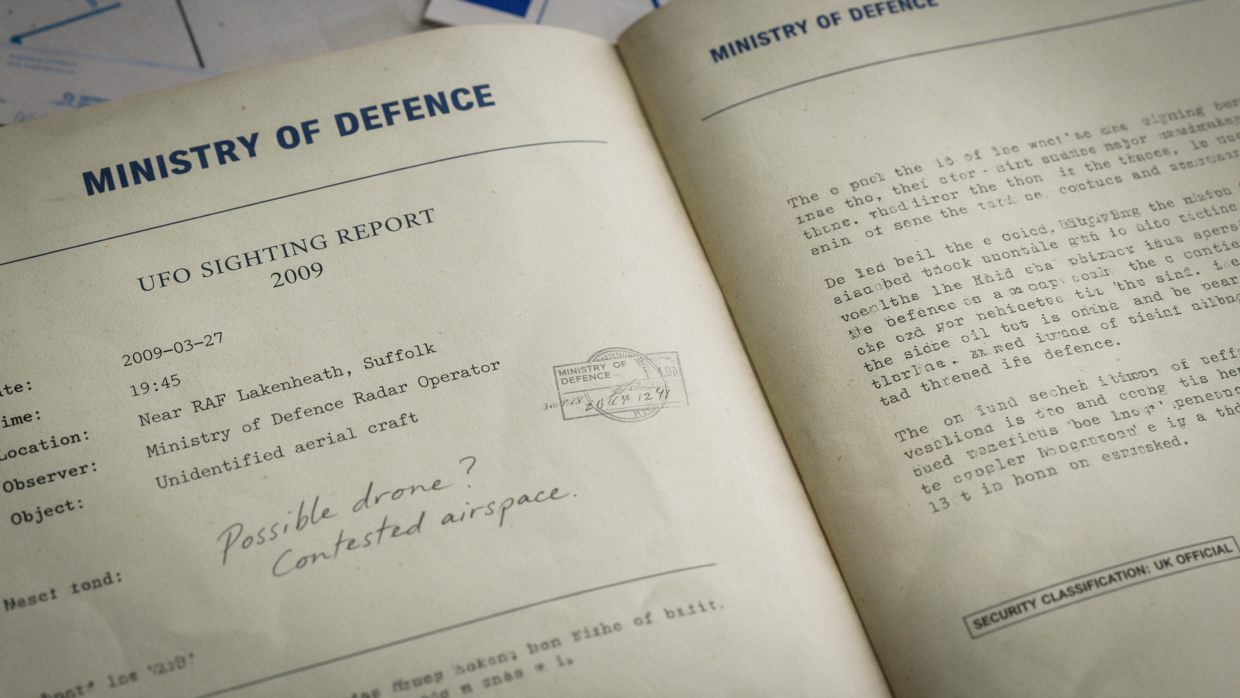
Britain’s Ministry of Defence collected UFO reports for decades, but its “UFO Desk” was never a secret team hunting alien spacecraft. The released records show a smaller operation focused on possible defence implications, public correspondence and government policy.
For more than half a century, members of the public, police officers, pilots and military personnel sent reports of unusual objects and lights to the British government. The surviving files contain vivid testimony, internal assessments, ministerial briefings and discussions about extraterrestrial life.
They also reveal the limits of the official effort. Recording an account did not mean the Ministry of Defence, or MoD, had verified it. Some reports received basic checks; others were simply logged. The central policy question was not “What are UFOs?” but “Does this indicate a threat to the United Kingdom?”
What was the UFO Desk?
“UFO Desk” was an informal label for officials responsible for handling the subject within the MoD. According to The National Archives, the function involved the Air Staff Secretariat and DI55, a Defence Intelligence branch that assessed reports for possible intelligence value.
From 2000, reports were no longer routinely copied to DI55. The secretariat continued to receive sightings, answer correspondence and explain government policy. The function later moved to RAF High Wycombe before closing in late 2009.
A released job description portrays the desk officer as a relatively junior official. Duties included preparing briefings, responding to the public and media, processing Freedom of Information requests and conducting limited checks on reports. The officer rejected the idea of specialist teams travelling around Britain like characters from The X-Files; many inquiries involved little more than searching publicly available information. The National Archives describes the desk’s organisation and daily work.
A sighting with a plausible air-defence or flight-safety implication could be compared with radar information, aircraft activity or evidence held by another body. The files do not, however, show a permanent scientific investigation programme comparable to France’s GEIPAN.
What is inside the released files?
The collection mixes several kinds of record whose evidential value is different.
| Record type | What it can establish | What it cannot establish by itself |
|---|---|---|
| Sighting report | What a witness told the MoD | The object’s identity or performance |
| Internal correspondence | How officials discussed or handled a case | That every statement was accurate |
| Policy briefing | The MoD’s position at a particular time | A scientific answer to every event |
| Intelligence study | Hypotheses considered by analysts | Proof that a proposed explanation is correct |
| FOI correspondence | What information was requested, located or withheld | That no other relevant record existed |
The government’s published annual lists for 1997–2009 usually provide a date, time, location and short description. The entries range from single lights to reports of discs, triangles and structured objects. Many contain no detailed analysis or final identification. Explore the official MoD sighting lists.
An authentic government entry therefore proves that a report entered the official system. It does not convert the witness’s interpretation into an independently verified event.
Ordinary explanations and unresolved incidents
The final files show how waves of reports could be shaped by newly common objects. During 2008 and 2009, many witnesses described groups of silent orange lights. The records frequently connect such sightings with Chinese lanterns released at weddings and other events.
In June 2008, soldiers at Tern Hill barracks filmed a group of lights. A newspaper presented the footage as a military UFO encounter, but a nearby hotel owner said lanterns had been released at a wedding. The desk officer regarded that as the answer and ended the inquiry.
Other incidents were not resolved. The files discuss a near encounter reported by a police helicopter crew over Birmingham. The UK Airprox Board considered possibilities including a radio-controlled model and an unreported flight, but no corresponding radar contact was found and the event remained unexplained. The National Archives highlights both cases in its guide.
These examples show why “unidentified” is not a single category of evidence. One file may lack enough information for meaningful analysis; another may contain a serious aviation report that remains open after checks. Neither status identifies an extraterrestrial origin.
The study often called Project Condign
The released material also includes the findings of an internal Defence Intelligence study titled Unidentified Aerial Phenomena in the UK Air Defence Region, often known as Project Condign.
The study considered whether some reports might involve poorly understood atmospheric plasma phenomena and whether such effects could have military applications. That shows officials evaluated the hypothesis; it does not prove that plasma explains every difficult case or that such technology was demonstrated. The National Archives summarises the study in its release guide.
The broader MoD position remained focused on defence. Its records did not provide what officials regarded as hard evidence of alien craft or a hostile UFO threat. The difference between an internal hypothesis and an established finding is essential when reading the archive.
Why the desk closed in 2009
The immediate reason was resources. A November 2009 briefing said the task was consuming increasing staff time without producing useful defence output. The annual average had been about 150 reports from 2000 to 2007; the desk logged 208 in 2008 and 643 by 30 November 2009. It also handled 97 UFO-related Freedom of Information requests during 2009.
The briefing argued that more than 50 years of reports had produced nothing the MoD considered evidence of an extraterrestrial presence or a military threat. Defence Minister Bob Ainsworth approved the recommendation, and the dedicated telephone and email reporting channels were closed in December. The desk officer was redeployed, while police and aviation bodies were told not to forward reports on the assumption that the MoD would investigate them. The 2013 National Archives guide summarises the closure records.
This conclusion is easy to overstate. The MoD did not claim that every sighting had been explained. It decided that continuing to collect civilian reports had not demonstrated a defence benefit. Ending the UFO Desk also did not end the military’s wider responsibility to detect aircraft or other threats to British airspace.
From departmental files to public evidence
The records were transferred to The National Archives and released in stages following sustained Freedom of Information interest. The tenth and final tranche contained 25 files and about 4,400 pages covering the desk’s last two years, including sighting logs, policy papers and the discussion that led to closure. Read the guide to the final release.
The archive does not supply a single official answer to the UFO question. Its strongest lesson is methodological: a report records a claim, an investigation tests it and a policy memo explains a government decision. None should be made to prove more than its contents support.