Popular culture did not invent government secrecy around UFOs. But old television plots are not evidence that today’s UAP claims were known in advance. Declassified records reveal a more complicated relationship between real investigations, folklore and official attempts to shape public perception.
When NBC premiered Dark Skies on September 21, 1996, the series presented a version of American history in which the public record concealed a second reality.
Roswell had exposed an extraterrestrial presence. A secret organization based on the disputed Majestic-12 story was attempting to contain it. Familiar political events unfolded alongside a hidden struggle over information the public was never supposed to know.
Three decades later, parts of the premise can sound strikingly similar to allegations now heard in the UAP disclosure debate: secret programs, recovered technology, information withheld from Congress and claims involving non-human intelligence.
The resemblance is real. What it means is less obvious.
There is no public evidence that Dark Skies was revealing classified knowledge. Contemporary reporting shows that creators Bryce Zabel and Brent Friedman were deliberately constructing fiction from historical events and existing UFO literature. The more consequential question is how genuine government secrecy, unverified UFO claims and popular culture have repeatedly reinforced one another.
Dark Skies was built from an existing UFO mythology
In a 1996 interview with The Washington Post, Zabel described how the production team created an extensive historical timeline, compared real events with reports from UFO literature and then devised fictional explanations connecting them.
That distinction matters.
Concepts such as Roswell cover-ups, secret government groups and extraterrestrial retrieval programs did not originate with Dark Skies. The series dramatized ideas that had already circulated for years.
Majestic-12 is a useful example. Alleged documents describing a secret group established to manage extraterrestrial recoveries surfaced publicly in the 1980s. But official archival research has never established the organization’s existence. The U.S. National Archives found numerous inconsistencies in the purported documentation and could find no supporting references in relevant government records. FBI files say an Air Force investigation concluded that an alleged Majestic-12 document was bogus.
That does not prove that every allegation of a secret UFO program is false. It means Dark Skies cannot be treated as independent evidence for one. The television series inherited the claim from UFO culture rather than corroborating it.
The Men in Black legend grew beside real investigations
The same problem appears in the history of the Men in Black.
One early strand comes from the controversial 1947 Maury Island story. Harold Dahl claimed that after an extraordinary flying-saucer incident near Puget Sound, a mysterious man wearing a black suit warned him against discussing what he had seen.
The underlying case is weak evidence for anything extraordinary. According to HistoryLink’s account, an FBI investigation concluded that Dahl and Fred Crisman had fabricated the saucer story, with the supposed debris consisting of ordinary material. The story nevertheless became part of later UFO literature.
The mythology expanded during the 1950s. UFO researcher Albert Bender claimed that three strangely behaving men visited him after his work with the International Flying Saucer Bureau. Writer Gray Barker brought the story to a much larger audience in his 1956 book They Knew Too Much About Flying Saucers.
But there was a real institutional backdrop that made such stories easier to believe.
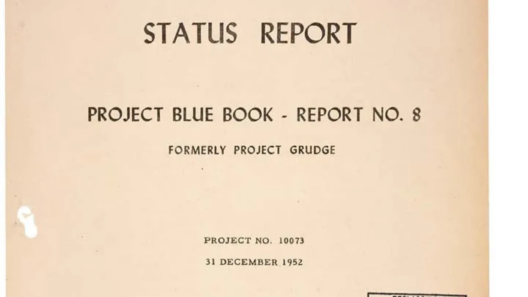
The U.S. Air Force’s 4602nd Air Intelligence Service Squadron genuinely investigated UFO reports in cooperation with Project Blue Book. Its personnel were trained in interrogation and counterintelligence, although their responsibilities extended far beyond UFOs. The National Archives today holds surviving case files from the unit.
The FBI also acknowledges that, for several years after 1947, agents were instructed to verify some UFO reports at the request of the Air Force. That involvement ended in 1950.
None of this demonstrates that government agents systematically threatened UFO witnesses. It does show how a folklore of mysterious official visitors could develop alongside the documented reality that intelligence and law-enforcement personnel sometimes did investigate UFO reports.
The CIA really did discuss shaping public perception
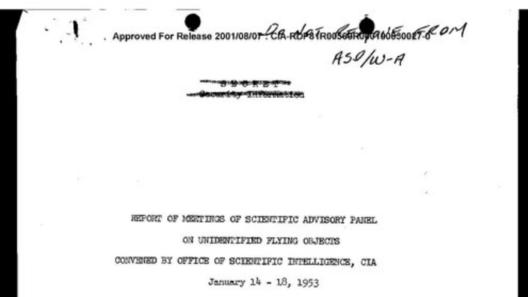
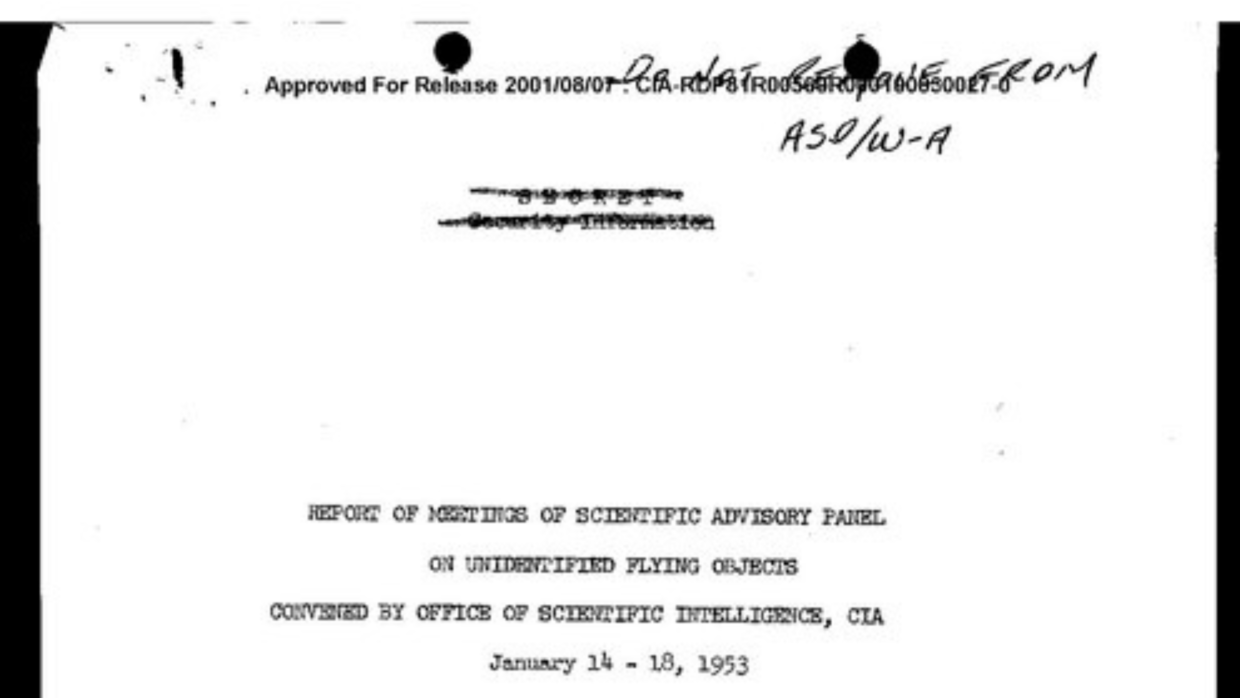
The strongest documented connection between government activity and public perception comes from the CIA-sponsored Robertson Panel of January 1953.
The panel was convened during an intense period of Cold War concern about UFO reports. Its scientists did not conclude that the sightings represented extraterrestrial spacecraft. Instead, they worried about the consequences of widespread reporting itself.
According to the CIA’s own historical review, panel members feared that large numbers of UFO reports could overload military communications, encourage public anxiety and potentially be exploited by an adversary attempting to confuse U.S. air defenses.
The response they proposed was explicitly informational.
The panel recommended what the CIA history describes as a program of “debunking” and public education. Suggested channels included mass media, advertising, business organizations, schools and even the Disney corporation.
That is an important historical fact.
But it is not evidence of a government program designed to prepare the public for eventual confirmation of extraterrestrial life. The documented goal was almost the reverse: to reduce public concern about UFOs and discourage reports that officials considered disruptive.
The same CIA history also records another element relevant to the modern disclosure debate. Agency officials wanted CIA involvement in UFO research kept from the media and public, partly because they feared that acknowledgement of CIA interest would itself be interpreted as confirmation that UFOs were extraordinary. The CIA historian later concluded that this secrecy contributed substantially to accusations of a government cover-up.
That creates a paradox that remains relevant today: secrecy intended to control speculation can ultimately generate more of it.
Why fiction can appear to predict disclosure
This helps explain why yesterday’s science fiction can resemble today’s political debate without requiring a secret Hollywood disclosure program.
UFO culture operates as a feedback system.
Witness reports and government investigations generate stories. Those stories become books, films and television. Popular culture makes particular explanations familiar — secret bases, recovered craft, agents silencing witnesses, hidden government factions. Later claims are then heard through a cultural vocabulary that already exists.
That does not mean an unusual sighting or whistleblower allegation should be dismissed merely because something similar appeared in fiction.
It means similarity is not corroboration.
A claim about recovered non-human technology made today must be judged by the evidence supporting that claim: documents, physical material, firsthand testimony, chain of custody, independent witnesses and the possibility of alternative explanations. A television series from 1996 neither proves nor disproves it.
What the historical record actually supports
The documentary record is already significant without extending it beyond what the evidence shows.
U.S. agencies investigated UFO reports. Intelligence officials worried that the phenomenon could have national-security consequences even when they did not believe the reports demonstrated extraterrestrial visitation. Government personnel sometimes concealed the extent of official interest. And the CIA-sponsored Robertson Panel explicitly discussed using mass communication to influence how the public viewed UFO reports.
Those facts deserve scrutiny in any serious history of disclosure.
What the available record does not establish is a coordinated, decades-long government operation in which Hollywood productions such as Dark Skies were deliberately used to prepare the population for confirmation of non-human intelligence.
For disclosure journalism, that boundary matters.
The history is neither as simple as “it was all fiction” nor as convenient as “fiction was telling us the truth.”
The more defensible conclusion is that official secrecy, genuine investigations, disputed claims and popular storytelling have been interacting for almost eighty years. Understanding that feedback loop is necessary if new evidence is to be evaluated on its own merits rather than through narratives inherited from the past.
Sources
CIA — CIA’s Role in the Study of UFOs, 1947–90
FBI — UFOs and the Guy Hottel Memo
National Archives — Project BLUE BOOK and Majestic-12 reference report
Smithsonian Air & Space — The Original Men in Black?
HistoryLink — The Maury Island Incident
The Washington Post — Dark Skies, October 1996
Los Angeles Times — Dark Skies premiere review, September 21, 1996