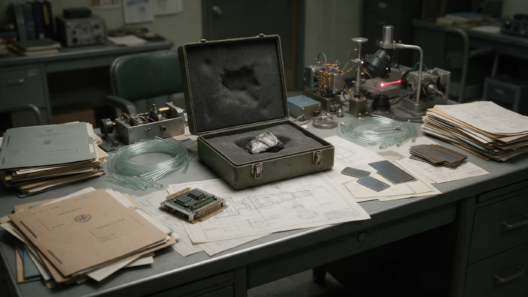
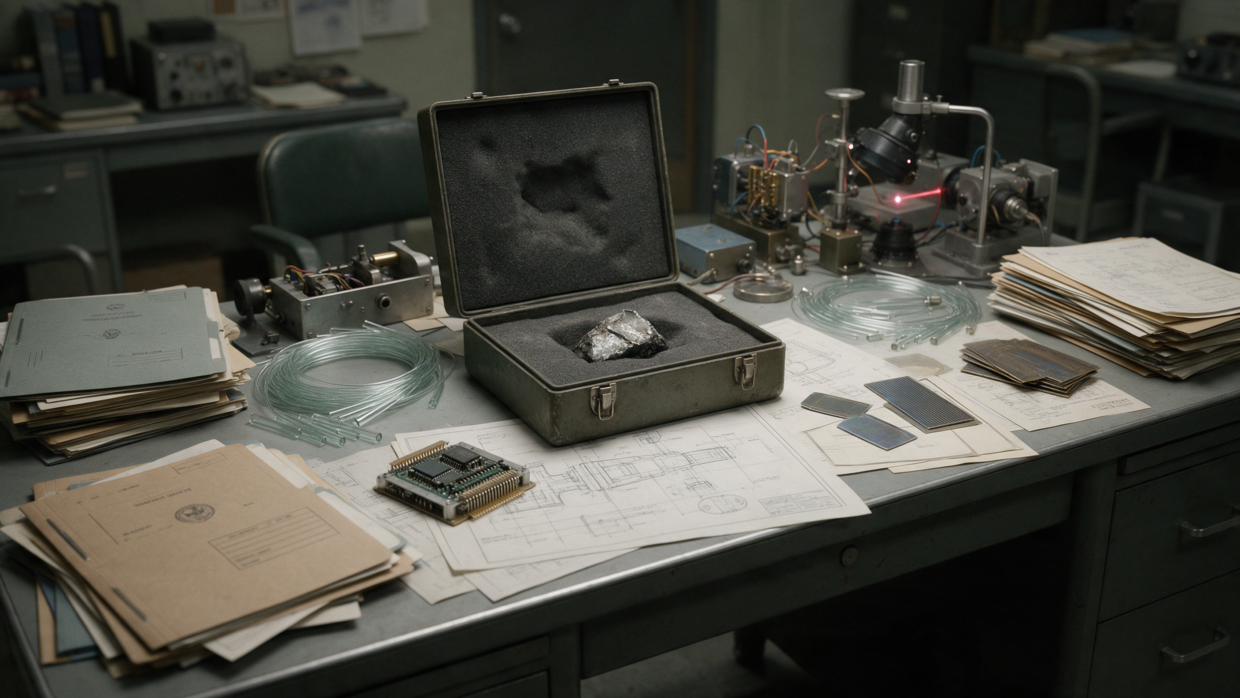
Philip J. Corso claimed that technology recovered at Roswell was quietly fed into U.S. military research and helped accelerate integrated circuits, lasers and fiber optics. His military career was real. The alleged technology-transfer program remains unverified — and the documented history of those inventions presents a serious test of his account.
When The Day After Roswell appeared in 1997, its central claim went far beyond the familiar argument that something unusual had crashed near Roswell, New Mexico, fifty years earlier.
Retired U.S. Army Lieutenant Colonel Philip J. Corso said the United States had not merely recovered an extraterrestrial spacecraft. He claimed that parts from it had subsequently been placed in his custody and quietly introduced into existing military research programs, influencing some of the defining technologies of the twentieth century.
Integrated circuits. Lasers. Fiber optics. Advanced high-strength materials. Image intensification.
Corso, writing with William J. Birnes, presented himself not as an outside UFO researcher but as one of the people who had participated in the process. The Day After Roswell was first published by Pocket Books in 1997, and its chapter structure explicitly traces alleged Roswell technology into areas including integrated circuitry, lasers and fiber optics.
Nearly three decades later, the book remains one of the strongest reverse-engineering claims ever made by a named former Pentagon official.
It also remains unproven.
Corso was a real military insider
The first reason the story has endured is that Corso’s government background was not invented for the book.
He served in the U.S. Army from 1942 until 1963 and retired as a lieutenant colonel. He worked on the staff of President Dwight Eisenhower’s National Security Council and later served within Army Research and Development at the Pentagon, including its foreign-technology work. His publisher identifies him as having become chief of the Pentagon’s Foreign Technology desk.
That gives Corso’s testimony more significance than an anonymous account.
It does not validate the account itself.
Government officials can accurately describe their careers while being mistaken, exaggerating, relying on secondhand information or making claims that cannot subsequently be verified. The question is therefore not whether Corso worked inside the national-security establishment.
He did.
The question is whether the extraordinary program he described can be independently demonstrated.
A body at Fort Riley and a file cabinet at the Pentagon
Corso said his involvement began shortly after the Roswell incident.
He claimed that while stationed at Fort Riley, Kansas, in July 1947, he encountered a military shipment containing what appeared to him to be a small non-human body being transported east. He did not claim to have witnessed the actual Roswell crash or recovery.
Years later, while working in Army R&D, he said he inherited files and physical material connected to Roswell.
According to the book, his superior, Lieutenant General Arthur Trudeau, authorized him to introduce promising technologies into existing military research and contractor networks without revealing where they had allegedly originated.
Rather than announce that a device had come from a crashed spacecraft, Corso’s account describes something subtler: place a technological concept into a laboratory or development program already working in a related field and allow conventional research to carry it forward.
The publisher summarizes the book as Corso’s account of using recovered material to advance technologies including circuit chips and fiber optics.
If true, the process would make conventional technology histories incomplete.
Those histories therefore provide one of the clearest ways to test the claim.
The technology timeline creates a problem
The semiconductor story is particularly important.
Corso linked Roswell material to the development of integrated circuitry. But semiconductor research was already well underway independently.
William Shockley had organized solid-state research at Bell Laboratories by 1945. John Bardeen and Walter Brattain achieved transistor action on December 16, 1947, and demonstrated their point-contact transistor to Bell Labs officials on December 23. The documented research path involved wartime semiconductor work, theoretical advances and laboratory notebooks showing progressive experimentation.
The integrated circuit itself followed more than a decade later. Texas Instruments records that Jack Kilby demonstrated the first working integrated circuit on September 12, 1958.
The same problem arises elsewhere.
The first working laser was built by Theodore Maiman in 1960, but the underlying physics had a much longer documented history extending back to Albert Einstein’s theoretical work on stimulated emission in 1917.
Modern telecommunications fiber optics also followed a visible research trail. Charles Kao proposed the potential of low-loss optical fiber for communications in 1966, and researchers Donald Keck, Robert Maurer and Peter Schultz at Corning produced the first practical low-loss optical fiber in 1970.
These histories do not logically make hidden technological influence impossible.
But they create a demanding problem for Corso’s thesis.
If extraterrestrial artifacts materially accelerated these technologies, there should ideally be some trace of that intervention: transfer records, laboratory notes mentioning unexplained prototypes, contractor correspondence, scientists describing unusual outside input, samples with demonstrably anomalous properties or documentation linking Corso’s office to specific breakthroughs.
No such public evidence has established that chain.
Without it, known technological development provides a sufficient explanation without requiring Roswell material.
The Roswell record does contain gaps
The broader Roswell record is not as complete as either side of the debate sometimes suggests.
A congressional request led the U.S. General Accounting Office — now the Government Accountability Office — to conduct an extensive search for government records in the 1990s.
GAO found two relevant records originating in 1947: a Roswell Army Air Field history and an FBI teletype. Both reflected the military’s contemporary explanation involving a balloon and radar reflector. GAO also found no Air Materiel Command records documenting examination of Roswell debris at Wright Field.
But the search also established that some Roswell Army Air Field administrative records and outgoing messages covering the relevant period had been destroyed. The disposition documentation did not state who destroyed them, when they were destroyed or under what authority.
GAO also cautioned that record-keeping practices from that era were imperfect, and the archivist it consulted noted that many Air Force records from the period had been destroyed without proper disposition citations.
That is a genuine gap in the archive.
It is not evidence that those missing records contained information about extraterrestrial recovery operations.
The distinction matters.
The official explanation remains Project MOGUL
The U.S. Air Force concluded in its 1994 Roswell investigation that the debris recovered in 1947 most likely originated from Project MOGUL, a classified balloon program designed to help detect Soviet nuclear tests.
Its subsequent Roswell Report: Case Closed attributed later stories involving bodies to a combination of anthropomorphic test-dummy recoveries and memories of later military accidents that, according to the Air Force, became compressed into the 1947 narrative over time.
Corso’s account is incompatible with that conclusion.
He describes biological remains, engineered materials and a decades-long exploitation program. The Air Force describes a classified balloon project followed by mythology built from unrelated later events.
Those are not minor variations of the same history.
A credible résumé is not corroboration
Corso’s case illustrates a recurring problem in disclosure reporting.
His rank, assignments and access make his testimony worthy of examination.
They do not substitute for evidence supporting the specific claim.
The most consequential part of The Day After Roswell is not that a retired lieutenant colonel believed Roswell involved extraterrestrial technology. It is his assertion that he personally participated in transferring that technology into American research and industry.
That should, in principle, be testable.
Companies received material. Scientists examined it. Programs were funded. Reports were written. Technologies supposedly moved through identifiable institutions.
If that happened on the scale Corso describes, records or independently corroborating witnesses may still exist.
Until such evidence emerges, The Day After Roswell occupies an unusual position in disclosure history: an extraordinary allegation made by someone with genuine government credentials, attached to technological developments whose conventional histories are also extensively documented.
Corso gave disclosure researchers a hypothesis.
Nearly thirty years later, the missing piece remains the same:
the evidence showing that Roswell technology actually entered the pipeline.
Sources
- The Day After Roswell — Simon & Schuster
- The Day After Roswell — WorldCat 1997 edition
- GAO — Government Records: Results of a Search for Records Concerning the 1947 Crash Near Roswell
- U.S. Air Force — The Roswell Report: Case Closed
- Computer History Museum — Invention of the Point-Contact Transistor
- Texas Instruments — History of Jack Kilby’s Integrated Circuit
- Corning — History of Optical Fiber Innovation
- American Physical Society — Theodore Maiman and the First Working Laser