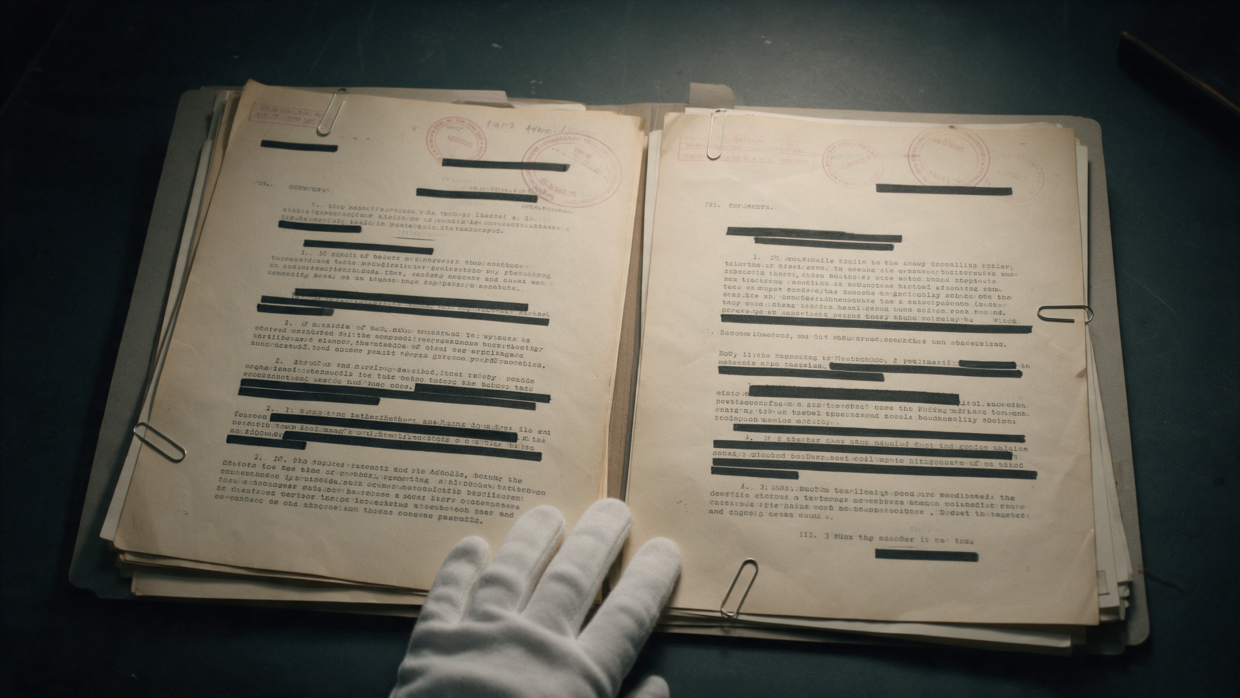
These labels describe a document’s status or path to the public. They do not establish whether the claims inside it are true.
UFO documents are frequently called “declassified” when they were merely released, uploaded without authorization or never classified. A document’s status explains how information was handled. Its evidential value depends on who created it, why and what supports its contents.
| Term | What it means | What it does not prove |
|---|---|---|
| Declassified | An authorized decision removed national-security classification from information | That the entire document is public or its contents are correct |
| Released | An agency or archive officially made a copy available | That it was previously classified or released without redactions |
| Leaked | A copy reached the public outside an authorized release process | That it is authentic, complete, declassified or false |
Declassified: a security status has changed
Under the US system, information may be classified when unauthorized disclosure could damage national security and it concerns defined subjects such as military operations, intelligence activities or certain technologies. Executive Order 13526 governs this process.
Declassification means an authorized reviewer determined that some or all of the information no longer requires that protection. Official copies may carry markings identifying the review authority and date. NARA’s guidance on document markings.
Declassification is not necessarily the final step before publication. Privacy, statutory or law-enforcement restrictions may still apply, so a record no longer classified for national-security reasons can remain partly restricted. NARA’s overview.
Released: an official copy is publicly accessible
An officially released document may appear in an archive, agency reading room, report appendix or Freedom of Information Act response. It may have been declassified first or unclassified from the beginning.
Release can be complete or partial. Under FOIA, agencies remove information covered by nine exemptions and should identify the exemption applied. A redacted page is still released, but it is not a complete view of the original. FOIA.gov’s guide.
For the federal UAP Records Collection, National Archives guidance requires metadata covering the originator, creation date, identifiers, classification history and whether a record is released in full, in part or withheld. Public copies enter the National Archives Catalog. NARA’s UAP guidance.
Inclusion in an official collection establishes provenance. It does not mean every file was once secret, every relevant record has been released or every statement within a file was verified.
Leaked: the route is unofficial
“Leaked” is not a classification level. It describes information made public without authorization. A leaked file may be genuine, altered, fabricated or assembled from both real and invented material. Even an accurate copy may lack pages or context.
Markings alone cannot authenticate a leak: letterheads, routing codes and stamps can be copied. Stronger verification comes from an official matching copy, agency confirmation or a documented chain of custody.
The US Navy videos commonly called FLIR1, GIMBAL and GOFAST show how status can change. Copies circulated after unauthorized releases in 2007 and 2017. In April 2020, the Department of Defense officially released the three unclassified videos, confirmed their Navy origin and continued to describe the phenomena as unidentified. The 2020 statement.
That confirmation authenticated the footage and clarified its source. It did not determine the identity or origin of the objects shown.
An authentic document can contain an unverified claim
Government files preserve witness reports, press summaries, internal questions, preliminary hypotheses, finished assessments and public correspondence. These do not have equal evidential weight.
An authentic memorandum proves that it exists and entered an official process. A pilot report establishes what was reported—not what caused the event. Filing a newspaper story or third-party allegation does not convert it into a government finding.
A raw report is not an analytical conclusion, and a draft is not final policy. Authenticity and accuracy must be assessed separately.
A practical document checklist
Before citing a UFO document, ask:
- Where did this copy come from? Prefer the originating agency, National Archives or an official reading room.
- Can it be identified? Check the title, agency, date, document number, record group and FOIA tracking information.
- What is its status? Look for classification and declassification markings, release dates, review authorities and exemption codes.
- What type of record is it? Distinguish a witness report, internal memo, intelligence summary, draft and final assessment.
- Is the file complete? Check page numbers, attachments, redactions and whether another version has been released.
- What does it actually establish? Separate the document’s existence from the truth of the events or allegations it describes.
The most important label is not “secret” or “leaked.” It is “verifiable.” Reliable reporting makes every document’s origin, status, context and limits clear enough for readers to examine.
Sources
- National Archives: Executive Order 13526
- National Archives: Identifying classification and declassification markings
- National Archives: Declassified Records
- FOIA.gov: Frequently Asked Questions
- National Archives: Guidance for the UAP Records Collection
- Department of Defense: Release of historical Navy videos, April 2020