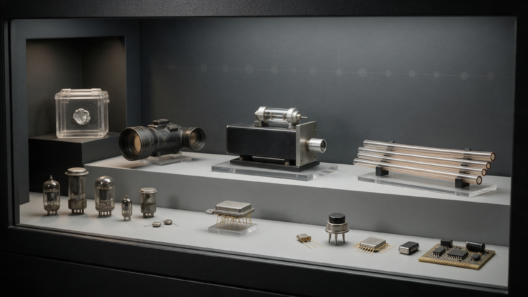
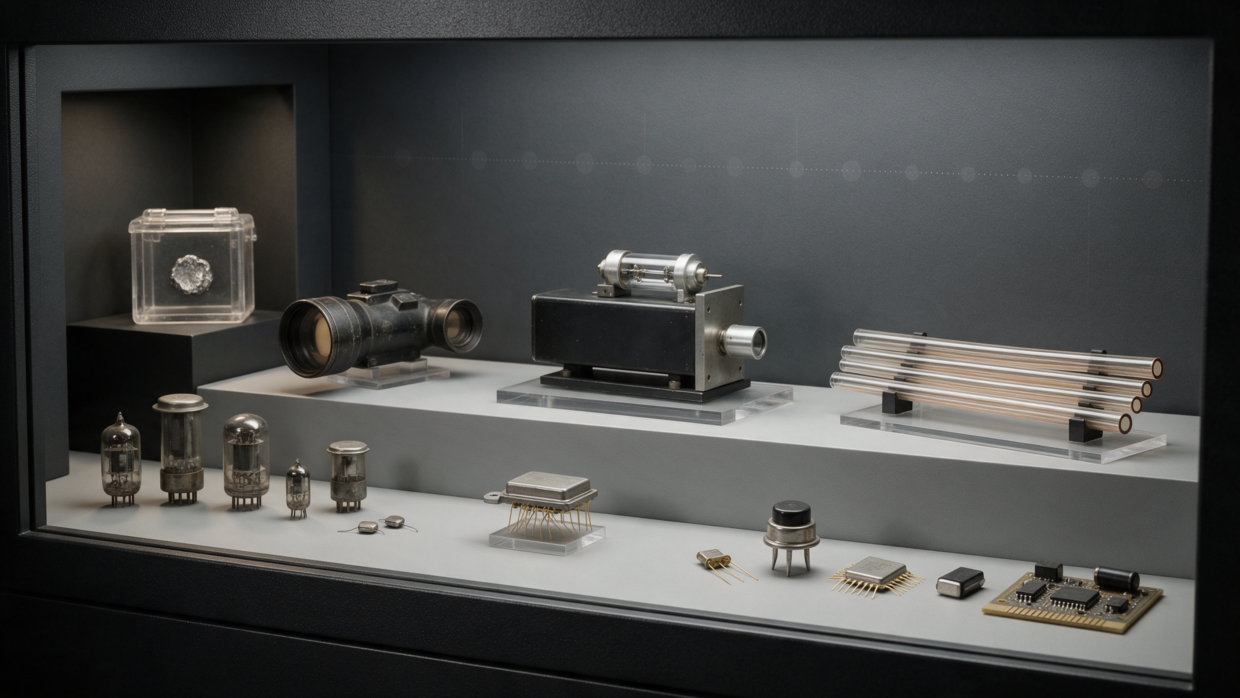
Philip Corso claimed technology recovered at Roswell was quietly introduced into American industry and helped produce integrated circuits, lasers, fiber optics and night vision. The technologies are real. Their development histories are unusually well documented — allowing one of the most extraordinary Roswell claims to be tested against the historical record.
The most testable claim in The Day After Roswell is not that something crashed in New Mexico in 1947.
It is what Philip J. Corso said happened afterward.
Corso claimed that when he joined the U.S. Army’s Research and Development organization in 1961, he inherited material recovered from the alleged Roswell craft. Working under Lieutenant General Arthur Trudeau, he said he quietly introduced that technology into existing military and industrial research programs.
In the book, Corso specifically linked the alleged material to integrated circuits, lasers, fiber-optic networks, high-strength fibers and other technologies.
This creates a rare opportunity in UFO history.
Instead of asking whether an unexplained light was extraterrestrial, we can examine the documented development of technologies Corso said came from Roswell.
The integrated circuit presents an immediate problem
At first glance, electronics might appear to support Corso’s story.
Roswell occurred in July 1947. John Bardeen and Walter Brattain demonstrated the first successful point-contact transistor at Bell Laboratories in December of that same year.
But the research trail did not begin after Roswell.
William Shockley had organized Bell Labs’ solid-state physics research group in 1945. Researchers were already investigating semiconductor alternatives to vacuum tubes using knowledge developed during and before World War II. Bardeen and Brattain’s December 1947 breakthrough emerged from that continuing work, with laboratory records documenting the experimental path.
The integrated circuit came still later.
British engineer Geoffrey Dummer publicly proposed the idea of integrating electronic components into a solid block in 1952. During the 1950s, multiple laboratories pursued miniaturized semiconductor circuits. Jack Kilby demonstrated his first working integrated circuit at Texas Instruments on September 12, 1958. Robert Noyce then developed the practical monolithic approach at Fairchild Semiconductor in 1959.
This chronology matters because Corso said the Roswell files came into his custody in 1961.
By then, the transistor existed, Kilby’s integrated circuit had been demonstrated, Noyce had filed his crucial patent, and commercial development was underway.
A hidden program could theoretically have influenced later improvements. But the proposition that Corso’s 1961 activity seeded the invention of integrated circuitry conflicts with a documented development process already well advanced before his claimed involvement.
The laser had roots going back to Einstein
Lasers pose a similar problem.
The underlying physical principle was not discovered in a mysterious Cold War laboratory. Albert Einstein described stimulated emission in 1917.
By the 1950s, researchers were working on masers — devices that amplified microwaves using related principles. Theodore Maiman began experimenting with ruby as a possible laser medium at Hughes Research Laboratories and demonstrated the first functioning ruby laser on May 16, 1960. IBM and Bell Labs demonstrated additional laser systems later that year.
Again, the date is important.
The first working laser existed approximately a year before Corso says he took control of the Roswell technology files.
That does not make secret influence logically impossible. But demonstrating such influence would require evidence showing where the alleged Roswell technology entered the documented research process.
No such public chain has been established.
Fiber optics is a more complicated case
Fiber optics developed later, which might initially appear more compatible with Corso’s timeline.
The idea of transmitting light through glass was not new, however. Glass fibers had already been used for imaging and medical purposes before modern telecommunications.
The decisive breakthrough for communications came from physicist Charles Kao. In 1966, Kao demonstrated that the main obstacle preventing long-distance optical communication was not a fundamental limitation of glass but impurities within it. He argued that sufficiently pure glass could carry light over useful distances. That work later earned him half of the 2009 Nobel Prize in Physics.
Corning researchers Robert Maurer, Donald Keck and Peter Schultz then spent years experimentally developing purer glass. In August 1970 they produced the first practical low-loss optical fiber, reaching the performance required for telecommunications.
That timeline overlaps the era in which Corso claimed Roswell-derived concepts were being moved into industry.
But overlap is not evidence of causation.
Kao’s publications, Corning’s experiments and the successive reduction in optical loss provide a documented engineering pathway. For the Roswell hypothesis to improve on that explanation, there would need to be evidence connecting Corso’s office or anomalous material to Kao, Corning or another identifiable part of the development chain.
None has been publicly demonstrated.
Night vision actually predates Roswell
Night vision creates an even clearer chronological problem.
The U.S. Army states that night-vision research was underway during World War II and that it developed an infrared sniper scope in 1945 — two years before the Roswell incident. About 300 reached soldiers in the Pacific.
Those early systems required an infrared illuminator.
Research continued through the 1950s toward passive systems capable of amplifying ambient moonlight and starlight. Army records describe work on cascade image tubes during that decade and later development of increasingly capable image intensifiers.
Corso specifically associated alleged Roswell artifacts with “image intensifiers,” which he said ultimately became night vision.
But the documented history shows night-vision technology evolving before, during and after Roswell through identifiable military research.
Again, an unknown external contribution cannot be disproved simply from a timeline.
What is missing is evidence that one occurred.
The timing is not Corso’s strongest argument
An important nuance is that Corso did not necessarily claim American engineers simply copied complete alien devices.
His model was subtler.
He said material and concepts were inserted into research programs already moving in similar directions. Scientists might therefore believe they had developed the technology conventionally without knowing that a military intermediary had accelerated the work.
That hypothesis is difficult to falsify.
It also creates a serious evidentiary problem.
If every documented human precursor can be explained as the program into which alien technology was secretly “seeded,” then conventional development can no longer count against the theory. The absence of unusual records becomes compatible with the cover-up, while technological success becomes evidence that the program worked.
A hypothesis constructed that way risks becoming impossible to test.
Corso’s claim becomes scientifically meaningful only if it predicts evidence that distinguishes the Roswell scenario from ordinary technological development.
What evidence should exist?
The alleged operation involved the U.S. Army, research laboratories and major industrial contractors.
That should potentially leave traces.
Transfer documentation. Correspondence. Unusual material samples. Laboratory notebooks recording unexpected external prototypes. Scientists describing unexplained input. Procurement records. Patent histories showing concepts appearing without technical predecessors. Multiple independent participants with firsthand knowledge.
Instead, the technologies most strongly associated with Corso have extensive development histories populated by identifiable researchers, intermediate experiments, failures, patents and publications.
This does not prove that every classified technological influence of the Cold War is known.
It does mean Roswell material is not required to explain the inventions.
A claim that disclosure could still test
Corso’s theory remains relevant because it resembles modern allegations that recovered UAP technology was transferred to private aerospace companies for exploitation.
If such programs existed, technological history could eventually become part of disclosure itself.
Declassification might reveal unusual transfers. Corporate archives could identify unexplained materials. Scientists might provide corroborating testimony. Physical samples could potentially be analyzed.
Until then, the historical record creates a difficult challenge for The Day After Roswell.
Transistors grew out of semiconductor research already underway before 1947. Integrated circuits emerged through a documented sequence during the 1950s. Lasers rested on decades of theoretical and experimental physics. Night vision existed before Roswell. Fiber optics followed a visible progression from optical theory to increasingly pure glass.
Corso proposed a hidden technological history underneath that documented one.
What he did not leave behind was the evidence needed to demonstrate that the hidden history was necessary.
Sources
Philip J. Corso and William J. Birnes — The Day After Roswell
Computer History Museum — Invention of the Point-Contact Transistor
Computer History Museum — Development of the Integrated Circuit
Computer History Museum — Robert Noyce and the Monolithic Integrated Circuit
Smithsonian Institution — Fifty Years of Lasers
Nobel Prize — Charles K. Kao and Optical Fiber