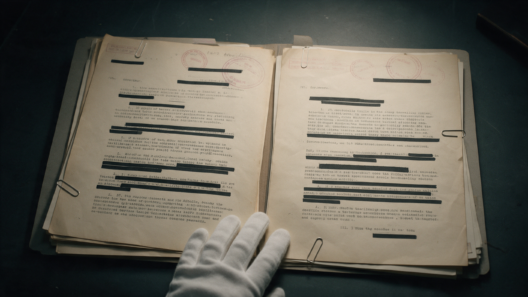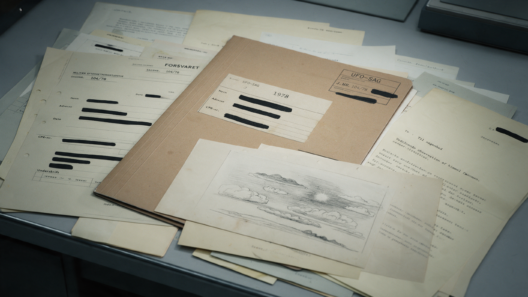
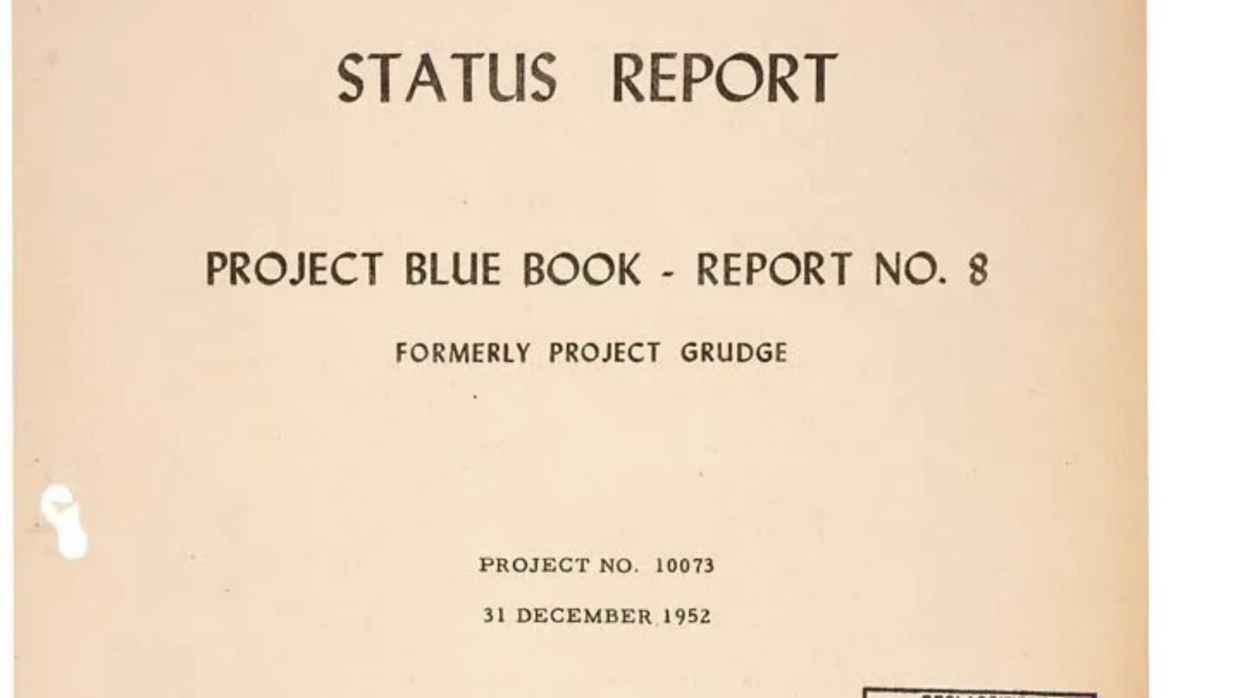
From 1952 to 1969, Project Blue Book collected and assessed thousands of UFO reports. Its archive documents serious investigations, ordinary explanations, unresolved cases and enduring questions about how the Air Force handled the subject.
Project Blue Book remains the best-known official UFO investigation in US history. Based at Wright-Patterson Air Force Base in Ohio, it examined reports from civilians, pilots, police officers and military personnel during the Cold War.
When the Air Force ended the project in 1969, it counted 12,618 sightings across its 1947–1969 investigative record. Of those, 701 remained classified as “unidentified.” That did not mean extraterrestrial; it meant investigators could not match a report to a known object or phenomenon using the available information.
From Project Sign to Project Blue Book
The Air Force’s organized inquiry began before Blue Book. Project Sign was established in 1948 as reports of “flying saucers” raised questions about air defense, intelligence and possible Soviet technology. Sign was followed by Project Grudge in 1949. In March 1952, the effort was reorganized under the name Project Blue Book.
Blue Book had three practical objectives: determine whether reported UFOs threatened US security, look for evidence of technological advances, and identify the object or event behind each report. Its immediate context was national security rather than a search for alien life. CIA history of Blue Book’s methods.
The Air Force’s final statistics include reports dating back to 1947, so the total of 12,618 covers the wider sequence of investigations rather than Blue Book’s 1952–1969 operating period alone.
How investigators assessed a sighting
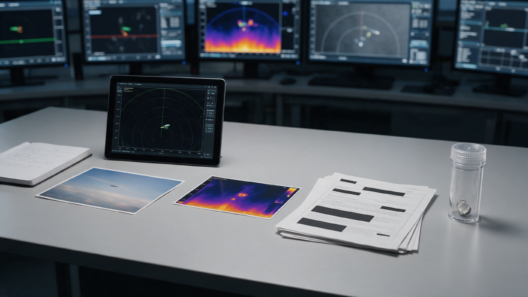
Witnesses were asked for the date, time, location, duration, weather, position in the sky, movement, sound and manner of appearance or disappearance. Investigators compared their accounts with astronomical information, weather data, aircraft activity and balloon launches.
Cases could be attributed to astronomical objects, aircraft, balloons, satellites or an “other” category covering possibilities such as birds, reflections, flares, false radar returns and hoaxes. Reports missing essential details went into a separate “insufficient data” category.
That distinction matters. Blue Book’s final chief, Hector Quintanilla Jr., explained that “unidentified” was reserved for a report that appeared to contain enough information to form a hypothesis but could not be correlated with a known object or phenomenon. Quintanilla’s released account of the investigation.
What the 701 cases do — and do not — establish
The 701 unidentified reports represented about 5.6 percent of the total. Most were assigned conventional explanations, including planets, meteors, balloons and aircraft. A 2024 Pentagon historical review also assessed that classified aviation and space programs probably contributed to some Cold War UFO reports. AARO’s Historical Record Report, Volume 1.
An unresolved classification establishes only that Blue Book did not reach an identification. It does not establish what the object was. Equally, the absence of an explanation should not be rewritten as a solved case without new evidence.
A case Blue Book could not close
One of the project’s best-documented unresolved cases occurred near Socorro, New Mexico, on 24 April 1964. Police officer Lonnie Zamora reported seeing an oval object near the ground before it rose and departed. Investigators checked aircraft, helicopters, balloons, radar and weather, and examined soil, radiation and burned vegetation.
The tests found no foreign material, abnormal radiation or propellant residue. Nevertheless, Quintanilla regarded Zamora as reliable and called the incident the project’s “best-documented case on record.” Blue Book eliminated several possibilities but did not determine the object’s origin. The released Socorro case account.
Why Project Blue Book ended
The immediate basis for closure was a University of Colorado study led by physicist Edward Condon, followed by a National Academy of Sciences review. The study concluded that two decades of UFO research had added little to scientific knowledge and that extensive further work was unlikely to advance science. The academy supported its general approach and recommendation.
On 17 December 1969, Secretary of the Air Force Robert C. Seamans Jr. announced Blue Book’s termination. The Air Force said its investigations had found no UFO that threatened national security, no evidence of technology beyond contemporary scientific knowledge and no evidence that unidentified sightings were extraterrestrial vehicles. The Air Force’s 1969 termination announcement.
The announcement also cited the view that legitimate defense concerns could be handled through normal intelligence and surveillance operations. Closing Blue Book therefore ended a dedicated UFO program; it did not mean the military would ignore an unidentified object with possible security implications.
Why the archive still matters
Blue Book’s conclusions remain disputed. AARO’s 2024 review notes that former project figures J. Allen Hynek and Edward Ruppelt later described pressure to explain reports away. Their accounts raise questions about institutional bias, while poor or missing measurements limited many investigations. Neither issue proves an extraordinary origin, but both affect how the conclusions should be judged.
The underlying records are now declassified. The National Archives holds administrative files, chronologically arranged case files, Office of Special Investigations material, photographs, films and sound recordings; the textual collection is available across 94 rolls of microfilm. National Archives guide to the Project Blue Book records.
That archive is Blue Book’s most important disclosure legacy. It allows the public to examine not only what witnesses reported, but also how the government collected evidence, assigned explanations and decided which questions remained open.