
A metallic specimen was submitted with claims of an unusual composition and a connection to a 1990s UAP event. Laboratory testing found a conventional industrial alloy—and showed why provenance matters as much as chemistry.
Unlike a distant light or short video, a physical sample can be imaged, dissolved, scanned and compared with known materials. Laboratory instruments test the specimen placed before them—not the story attached to it.
That distinction is central to an analysis prepared by Oak Ridge National Laboratory (ORNL) for the Pentagon’s All-domain Anomaly Resolution Office (AARO).
The claim and the samples
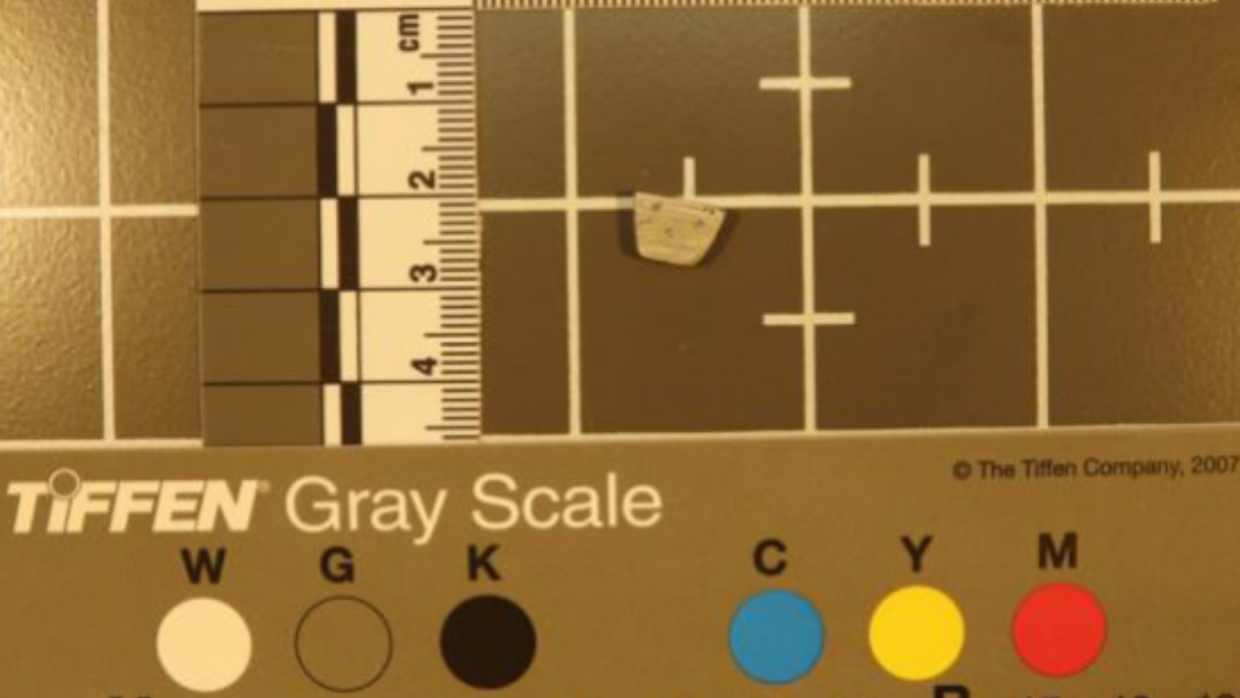
AARO asked ORNL to examine a metallic specimen claimed to be associated with an unidentified phenomenon over central Ohio in or around 1995. The material was also alleged to have an unusual composition. ORNL received three bags of drill shavings and one small sectioned piece from the specimen.
The laboratory examined its composition, internal structure and possible gamma-ray emissions.
The public report describes the connection to the Ohio event as a claim. It does not provide a documented chain of custody demonstrating where the original object was found, who handled it or how the submitted pieces were linked to that event. The tests could therefore evaluate the specimen’s properties, but not independently establish its history. Read ORNL’s report prepared for AARO.
How the material was tested
ORNL used several complementary techniques rather than relying on a single measurement.
| Method | What it examined | Reported result |
|---|---|---|
| Optical-emission and mass spectrometry | Major, minor and trace elements | Predominantly aluminium and silicon, with expected industrial alloying elements |
| Scanning electron microscopy and X-ray spectroscopy | Microscopic structure and distribution of elements | Phases typical of cast aluminium–silicon alloys |
| X-ray computed tomography | Internal pores and their three-dimensional pattern | Shrinkage porosity consistent with slow cooling in a mould |
| Gamma spectroscopy | Possible radioactive emissions | No signal distinguishable from background |
Separate techniques cross-checked the chemistry. The shavings and bulk piece matched within analytical uncertainties, while polished interiors helped distinguish the material from marks introduced during drilling.
A familiar aluminium–silicon alloy
The sample contained approximately 86 percent aluminium and 12 percent silicon by weight. Iron accounted for about one percent; copper, magnesium, zinc and manganese appeared in smaller amounts.
ORNL classified it as a conventional near-eutectic aluminium–silicon alloy. Such mixtures melt at relatively low temperatures and flow readily into moulds, making them useful for detailed cast components.
The composition was close to established industrial grades A413.1 and 369.1. Such alloys have long been used in automotive, aerospace and consumer products. Their use in aerospace applications does not imply an extraterrestrial origin; it describes one of several ordinary terrestrial industries that use the material. See the measured composition and standards comparison.
The structure recorded how it was made
A material’s microscopic structure can preserve evidence of manufacturing. ORNL observed silicon plates and needles in an aluminium matrix, iron- and manganese-rich intermetallic phases, smaller copper- and magnesium-bearing precipitates, and interconnected shrinkage pores.
The pores ranged from roughly half a millimetre to more than one millimetre. With the spacing of other features, they indicated gradual cooling in a relatively large casting. ORNL did not observe the finer structure expected from rapid quenching.
These features matched ordinary casting processes available since at least the late 1970s. Nothing in the examined microstructure required an unknown manufacturing method.
No gamma signal above background
ORNL monitored three samples with gamma spectroscopy for approximately two days and compared them with longer background measurements. The results were indistinguishable from background, with no radioactive emissions detected.
That finding addresses the specific type of radiation and sensitivity tested. It should not be expanded into a claim that every possible physical property was examined. Review the gamma-spectroscopy results.
What the conclusion does—and does not—establish
ORNL concluded that the supplied material was a conventional terrestrial aluminium alloy made through standard industrial methods. Its chemistry, microstructure, porosity and lack of gamma emission did not support claims of novel physics or an extraordinary origin.
The conclusion applies to the pieces examined. The laboratory did not identify the exact component from which they came. ORNL noted that samples from other parts of the original object or access to manufacturing records could help narrow the precise grade and heat treatment.
Nor does this one result settle every claim about alleged UAP material. It establishes something narrower: this particular specimen provided no laboratory evidence of unusual composition, manufacturing or gamma emission. Without documented provenance, even an unexpected laboratory result would still need a separate evidential bridge to any reported UAP event.
A stronger standard for future samples
A credible investigation begins before testing. Recovery, ownership and handling should be documented; contamination controlled; and representative pieces divided for independent analysis where possible.
Published methods, calibration standards, uncertainties and detection limits allow others to assess the results. Control samples and external replication strengthen them.
The ORNL analysis demonstrates why testing matters even when the result is ordinary. A dramatic origin story is a claim. Reproducible measurements determine whether the material itself supports it.