Denmark’s 2009 release offers a rare look at how military authorities recorded and assessed unusual observations. The files document reports and official responses—not proof of extraterrestrial craft.
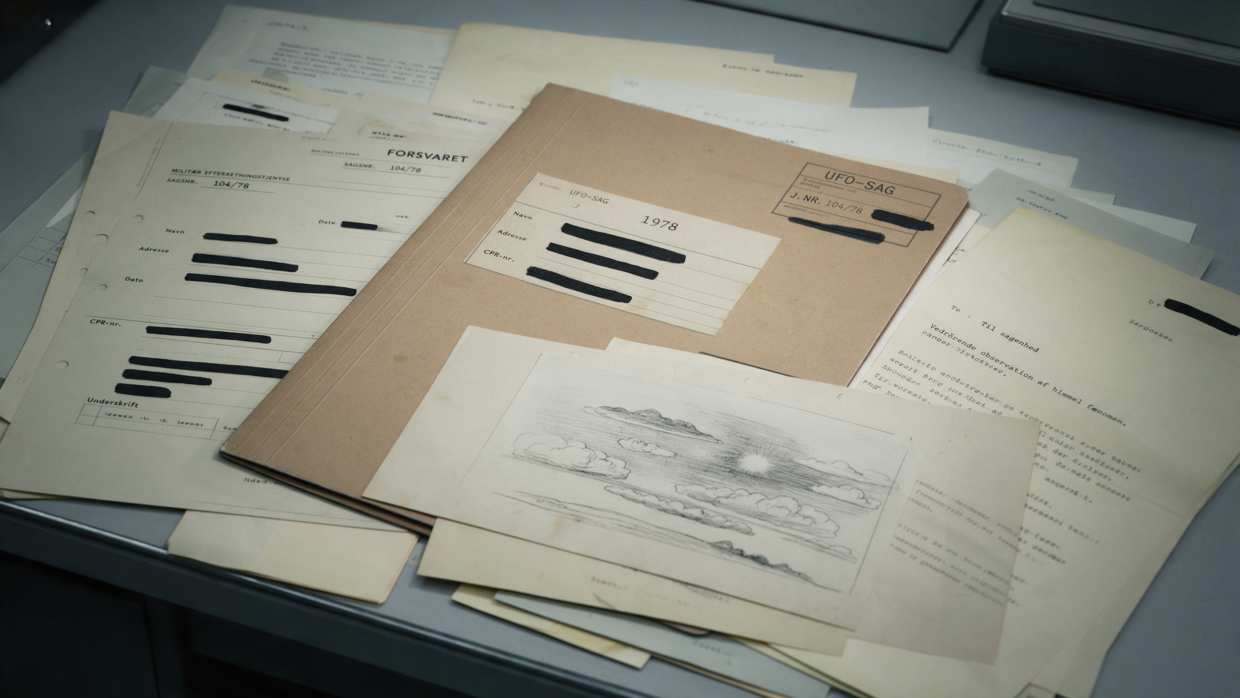
In 2009, the Royal Danish Air Force placed a long-running collection of UFO material online. Across four scanned PDF files covering pages numbered 1 through 329, readers can examine witness questionnaires, correspondence and official replies concerning objects or lights that observers could not initially identify.
The archive matters because it exposes part of the reporting process to public scrutiny. It shows what information officials requested, which possible explanations they considered and where the available evidence reached its limits.
One distinction is important from the outset. The Air Force’s official archive page says that the folder was made publicly available in 2009. It does not say that all of the material had previously been classified. Describing the files as a public release is therefore more precise than assuming every page was “declassified.”
What the 2009 release contains
According to the Air Force, its operations centre collected inquiries about unidentified flying objects over many years after the reports had been examined. The surviving material is available as four files labelled pages 1–99, 100–199, 200–280 and 280–329.
This is not a modern database or a single investigative report. It is a scanned working archive containing different kinds of records created for different purposes. A page may preserve a witness statement, a request for information, an internal assessment or a reply sent by the Air Force.
The page count should not be treated as a case count. One incident can generate several pages of correspondence, while a single document may discuss more than one observation. The official archive page does not claim that the collection represents every Danish UFO report.
How witnesses were questioned
Among the records is a standard questionnaire, Form 3622, intended for military and civilian authorities interviewing people about observed objects. It asks for the date, time and precise location of an observation, together with the direction and angle at which the object appeared.
The form also requests details about shape, colour, apparent size, sound, smoke, speed and flight direction. If an impact was reported, it asks where it occurred, whether debris was recovered and where any material was being held. The submitting authority could add an assessment of the source.
That structure is significant. It gave investigators a consistent set of questions and could help them compare a report with aircraft, astronomical objects, atmospheric effects or other known activity. But a structured form does not transform an eyewitness estimate into an instrument measurement. Apparent size, distance and speed can still be highly uncertain when reference points are missing.
What official assessments looked like
The files preserve conclusions as well as uncertainty. In a reply concerning an observation from Vejle on 13 January 1979, Flyvertaktisk Kommando—the Air Tactical Command—said it had no information about activity corresponding to the report. It nevertheless noted that some of the described characteristics were consistent with Venus.
The same section of the archive contains responses to several observations from 31 December 1978. Again, the command reported no known matching activity, but said a satellite re-entry could not be excluded. Both examples use conditional language: they offer plausible hypotheses without claiming conclusive identification. See the Air Force archive, part four.
Another 1979 response addressed questions about an alleged event over Aarhus in March 1973. The command reported that it had found no archival material about the event and explained that a low-flying object over Aarhus would have been below the coverage of radar at Karup because of the curvature of the Earth.
That reply does not reconstruct what happened in 1973. It documents what officials said they could—and could not—verify several years later. The response appears in part four of the archive.
What an unidentified report establishes
An authentic military record proves that a report, assessment or exchange entered an official file. It does not automatically prove that the observed object existed exactly as described, nor does it establish its origin.
Likewise, the absence of matching military activity is not evidence of non-human technology. It can mean that an object was civilian, astronomical, atmospheric or outside the available systems’ coverage. It can also mean that the surviving data were simply insufficient.
The Danish files are most informative when those evidentiary levels remain separate:
- what a witness said was observed;
- what information the Air Force could check;
- which explanations officials considered; and
- whether the record contains enough data to support a conclusion.
How to research the archive responsibly
International readers should begin with the official Air Force landing page and cite the relevant PDF part, document date and page or reference number. Automated text recognition is unreliable on faded scans, handwriting and older typewritten Danish, so claims found through searchable mirrors should be checked against the original image.
Researchers should also take care with personal details that may appear in historical forms. Names and addresses rarely add evidentiary value when discussing the investigation publicly.
The release does not settle the UFO question, and it should not be advertised as doing so. Its real contribution is traceability: it allows readers to see portions of the original record, distinguish reports from conclusions and test later claims against contemporary documents.